
The short version
- Modern AI video generators usually work in a compressed latent space instead of directly generating every full-resolution pixel.
- A prompt is encoded into numerical conditions while the video is represented as tokens or patches spanning both image space and time.
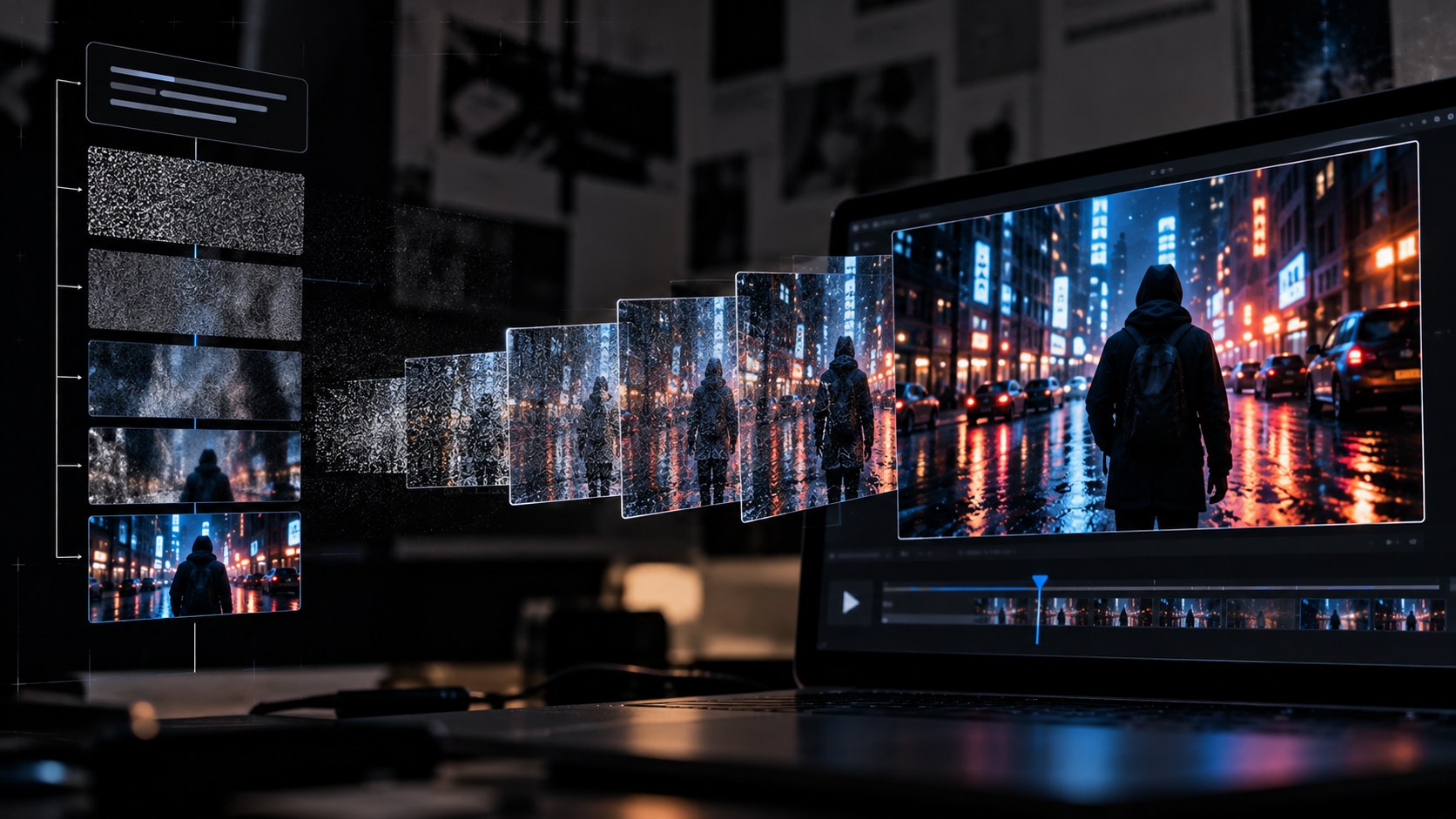
- Diffusion- or flow-matching-based systems begin from noise and repeatedly update those video latents; transformer attention helps coordinate subjects, motion, camera movement and nearby frames.
- The model learns statistical patterns of motion and appearance rather than running a literal physics engine, which is why convincing clips can still contain identity drift, broken causality and impossible motion.
The short version
An AI video generator is best understood as a machine that turns noise into a moving visual sequence under a set of conditions.
The conditions might be a text prompt, a reference image, an existing video, a first and last frame, a character reference or some combination of them. The model does not usually draw a perfect first frame, then a second frame, then a third as separate jobs. Modern systems increasingly work on a compressed representation of many frames together, so they can reason about what should exist across both space and time.
A simplified pipeline looks like this:
- Compress videos into a smaller latent representation.
- Break that representation into tokens or patches that include a time dimension.
- Encode the prompt and other references into numerical conditions.
- Start with a noisy latent video.
- Repeatedly transform that noise toward a video that matches the conditions.
- Decode the final latent back into viewable frames.
- Optionally run extra stages for higher resolution, frame rate, editing or audio.
The interesting part is step five. That is where the model has to make a face remain the same face, keep a cup in the same hand, decide how a camera should move and infer what happens when something passes behind something else.
It is also where most failures begin.
Training: the model first learns what video looks like
Before generation is possible, the model is trained on large collections of video, images and associated descriptions.
The exact datasets behind commercial systems are often not fully disclosed, but public technical work shows the broad recipe. Stable Video Diffusion emphasizes data curation and staged training. CogVideoX describes a pipeline that processes video data and generates detailed captions to improve text-video alignment. OpenAI’s 2024 Sora technical report similarly describes training on images and videos represented in a common visual format.
Captions matter more than they sound like they should.
If a training clip contains a woman turning toward the camera while rain falls behind her, the model benefits from a description that says exactly that. A vague caption such as “woman outside” contains much less information about motion, framing, weather and camera relationship. Better text-video pairs teach the model how language maps onto visible events.
During training, the system repeatedly sees a real video in compressed form with some amount of noise applied to it. Depending on the model and training objective, it learns to predict the noise, the clean sample or the direction that moves the noisy sample toward real data.
The error is measurable because the trainer knows what the original video looked like. Backpropagation adjusts the model’s weights. Repeat that across enormous numbers of examples and the network gets progressively better at recognizing which visual changes are plausible at different levels of noise.
It is not memorizing a lookup table of “dog runs left” or “camera pans right.” It is learning a very large statistical model of how appearance, language, motion and time tend to relate.
That distinction also does not mean memorization is impossible. Generative models can reproduce or closely resemble training material in some circumstances. The point is narrower: normal generation is not a stock-footage search followed by automated editing.
Video is compressed before the hard work starts
Raw video is brutal to process.
A still image already contains millions of pixel values. Video multiplies that by dozens of frames every second. Asking a giant transformer to operate directly on every full-resolution pixel across time would make training and generation vastly more expensive.
So modern systems generally compress the video first.
OpenAI’s Sora report describes a network that compresses video both spatially and temporally before generation. Wan uses a purpose-built spatiotemporal variational autoencoder, and CogVideoX describes a 3D VAE that compresses across both image dimensions and time.
This compressed representation is usually called latent space.
A latent is not a low-resolution thumbnail. It is a learned numerical representation that preserves enough structure for another model to reconstruct the video later, while throwing away a large amount of raw pixel redundancy.
The practical effect is huge: the expensive generative model can work on a smaller block of numbers instead of the original video.
| Part | What it does |
|---|---|
| Video encoder / VAE | Compresses pixels and frames into a smaller latent representation. |
| Text encoder | Converts the prompt into numerical features the generator can use. |
| Spacetime tokens or patches | Turn the latent video into manageable units spanning image area and time. |
| Transformer | Models relationships between those units and the conditioning information. |
| Diffusion or flow process | Moves the latent from noise toward a plausible video. |
| Video decoder / VAE | Converts the finished latent representation back into frames. |
This is why “AI video generation” is not one neural network performing one trick. A production system is a pipeline.
The transformer sees space and time as one problem
One of the major shifts in modern video generation is treating video less like a stack of unrelated images and more like a structured block of spacetime.
Sora’s public architecture is a clean example. After compression, it divides visual data into spacetime patches. Those patches act roughly like tokens for a transformer. A patch represents a region of the visual field across a slice of time, rather than a word in a sentence.
Other modern systems use different implementations, but the same engineering problem keeps appearing: the model needs an efficient unit for representing what is where, and when.
Transformer attention then lets information in one region relate to information elsewhere in the clip.
Imagine a red car driving behind a tree and reappearing on the other side. To make the shot work, the model has to preserve the car’s colour, shape, direction and speed while it is partly or fully occluded. It also has to keep the tree stable and reconcile the scene with any camera movement.
Generating each frame as an isolated image would make that much harder. A video transformer can model relationships across the sequence instead.
This is where “temporal consistency” comes from. It is not a final anti-flicker filter pasted onto a completed animation. It is something the generator is trained to maintain while the scene is being formed.
Diffusion and flow matching: different math, similar intuition
“Diffusion” is the term most people encounter first.
A diffusion model is trained around progressively corrupted data. At generation time, the process runs in the useful direction: begin with noise and take repeated steps toward structured visual data, with the prompt guiding what should emerge.
Many important video systems use this family of approach. Stable Video Diffusion is a latent video diffusion model. CogVideoX is a diffusion-transformer model. Sora was described as a diffusion model with a transformer operating on spacetime patches.
But “all AI video is diffusion” is already too simple.
Modern open models such as Wan use flow matching inside a diffusion-transformer-style architecture. Flow matching learns a continuous direction field that transports a simple distribution such as noise toward the data distribution. Sampling follows that learned flow through a series of numerical steps.
The mathematics differ, but the useful mental model is similar:
Start from an unstructured latent, repeatedly update it under the model’s guidance, and end at a structured video latent.
This is also why generation is expensive. The model does not usually make one giant forward pass and instantly emit the final movie. It may evaluate a very large transformer repeatedly as a sampler or solver moves through many steps.
Text-to-video, image-to-video and editing are variations of conditioning
The underlying generator can support very different workflows depending on what information it is conditioned on.
Text-to-video gives the model the most freedom. The prompt might specify a person, action, environment, lens and camera move, but the system still has to invent composition, identity, geometry, timing and countless details the user never specified.
Image-to-video constrains the problem. The reference image can be encoded and supplied as visual conditioning, giving the model a concrete identity, composition and starting appearance. The generator’s job becomes: keep enough of this image intact while inventing believable change over time.
Video-to-video and instruction-based editing constrain it further. A source clip provides existing motion and structure, while the model changes appearance, objects, style or other requested properties. Meta’s Movie Gen research is one public example of a model family designed for generation, personalization and editing rather than one isolated text-to-video task.
The same idea extends to first-frame/last-frame controls, character references, pose guidance and camera controls. Each additional input reduces the number of decisions the model must invent from scratch.
That is why image-to-video can sometimes feel more controllable than text-to-video even when both are powered by closely related models.
Why faces drift and objects still melt
A video can look photorealistic and still be structurally wrong.
That is not a contradiction. The generator is solving for visual plausibility, not maintaining a hidden database entry that says “this exact person owns this exact left hand and this exact watch for every frame.”
Identity and object state are distributed through the model’s internal representation. If attention, compression or conditioning is not strong enough, details can drift.
Several failure modes follow naturally:
- Identity drift: a face or outfit changes as the shot evolves.
- Object mutation: one object gradually changes shape or becomes another.
- Broken occlusion: something disappears behind an object and returns incorrectly.
- Causality errors: an effect appears before its supposed cause.
- Impossible mechanics: limbs, liquids, reflections or collisions behave in ways that look locally believable but fail globally.
- Text instability: letters and logos change because exact symbol persistence is harder than matching their general visual appearance.
Longer shots make these problems harder because the model has more temporal relationships to preserve.
Compression creates another tradeoff. The latent representation makes generation tractable, but every compression system decides which details are important enough to preserve. Tiny text, fingers, repeating patterns and subtle geometry are exactly the kinds of details that can expose weaknesses.
It is not a physics engine
The phrase “world model” can make AI video sound more literal than it is.
Video generators absolutely learn useful regularities about the world. They can learn that gravity usually points down, people tend to move in certain ways, cameras have recognizable motion patterns and objects often remain present after temporary occlusion. Scale makes those priors surprisingly powerful.
But a generated clip is not normally the output of a traditional simulator calculating rigid-body dynamics, fluid equations, material properties and exact 3D geometry before rendering each frame.
It is a learned generative model producing the sequence that best fits its training and conditions.
That difference matters.
A real simulator can be wrong because its equations or parameters are wrong. A video generator can be wrong because an impossible event still resembles enough patterns from real footage to look convincing for a moment.
The result is a peculiar capability: high visual realism without guaranteed physical truth.
That is one reason synthetic video changes the evidentiary value of “I saw a clip.” A polished video can be useful media while remaining weak proof of the event it depicts. The same context problem already exists with still images and screenshots; our guide to what screenshots can and cannot establish applies even more strongly once the pixels themselves can be generated over time.
Why AI video costs so much more than AI images
Video generation multiplies the problem in two directions.
Higher resolution creates more spatial information. Longer duration creates more temporal information. Even after compression, a model may need to coordinate a very large number of video tokens while repeatedly running transformer layers during sampling.
Meta’s Movie Gen research describes a video model with a context measured in tens of thousands of video tokens. OpenAI’s patch-based framing makes the scaling intuition simple: more duration, resolution or area means more visual patches to process.
That is why a few extra seconds can be a meaningful increase in compute rather than a trivial extension.
It also explains several common product limits:
- short maximum clip lengths;
- lower resolutions during initial generation;
- separate upscaling stages;
- credit prices that rise with resolution or duration;
- faster “draft” modes using fewer sampling steps or smaller models.
The expensive part is not saving an MP4. It is repeatedly running a large generative network over a spatiotemporal representation until the clip resolves.
Audio is becoming part of the same product, not necessarily the same model
AI video originally meant silent visual generation plus a separate soundtrack workflow.
That boundary is disappearing. Google DeepMind’s current Veo 3.1 product page includes text-to-audio-and-video generation, and Meta’s Movie Gen research includes synchronized audio generation alongside video.
That does not mean every system uses one monolithic network to generate every pixel and every waveform at once. Vendors can combine separate or jointly trained media models in different ways, and proprietary systems rarely disclose every implementation detail.
For a user, though, the interface is converging: describe a scene, and the system increasingly handles movement, dialogue, ambience and effects as one creative request.
The useful mental model
The simplest explanation of AI video is “it predicts frames.”
That is not completely wrong, but it hides the part that made modern systems much better.
A more accurate model is:
AI video generation compresses moving visual data into a latent spacetime representation, conditions that representation on text or reference media, and uses a large generative transformer to iteratively turn noise into a coherent sequence before decoding it back into pixels.
The model is not drawing like an animator, searching stock footage like an editor or simulating reality like a physics engine.
It is learning the statistical structure of moving images well enough to generate a new one.
The reason today’s clips can look startlingly real is that the model has learned an enormous amount about how the world tends to look over time.
The reason they still fail in startling ways is that “tends to look right” and “is actually consistent and physically true” are not the same thing.
Sources & reference material
- Video generation models as world simulatorsOpenAI · Accessed Oct 10, 2026
Technical reference for compressing video into latent space, representing it as spacetime patches and using a diffusion transformer to generate visual data.
- Wan: Open and Advanced Large-Scale Video Generative ModelsWan Team / arXiv · Accessed Oct 10, 2026
Technical reference for modern open video generation using a spatiotemporal VAE, a diffusion-transformer architecture and flow matching.
- CogVideoX: Text-to-Video Diffusion Models with An Expert TransformerZhipu AI, Tsinghua University / arXiv · Accessed Oct 10, 2026
Technical reference for spatial-temporal video compression with a 3D VAE, transformer-based text-video fusion, progressive training and captioned video data.
- Movie Gen: A Cast of Media Foundation ModelsMeta AI · Accessed Oct 10, 2026
Reference for large transformer-based media models, video-token context, text-to-video generation, video editing, personalization and synchronized audio generation.
- Stable Video Diffusion: Scaling Latent Video Diffusion Models to Large DatasetsStability AI · Accessed Oct 10, 2026
Reference for latent video diffusion, image-to-video generation and the importance of video-data curation and staged training.
- Veo 3.1Google DeepMind · Accessed Oct 10, 2026
Current product reference showing that modern video generators can combine text-to-video and image-to-video generation with native audio.