
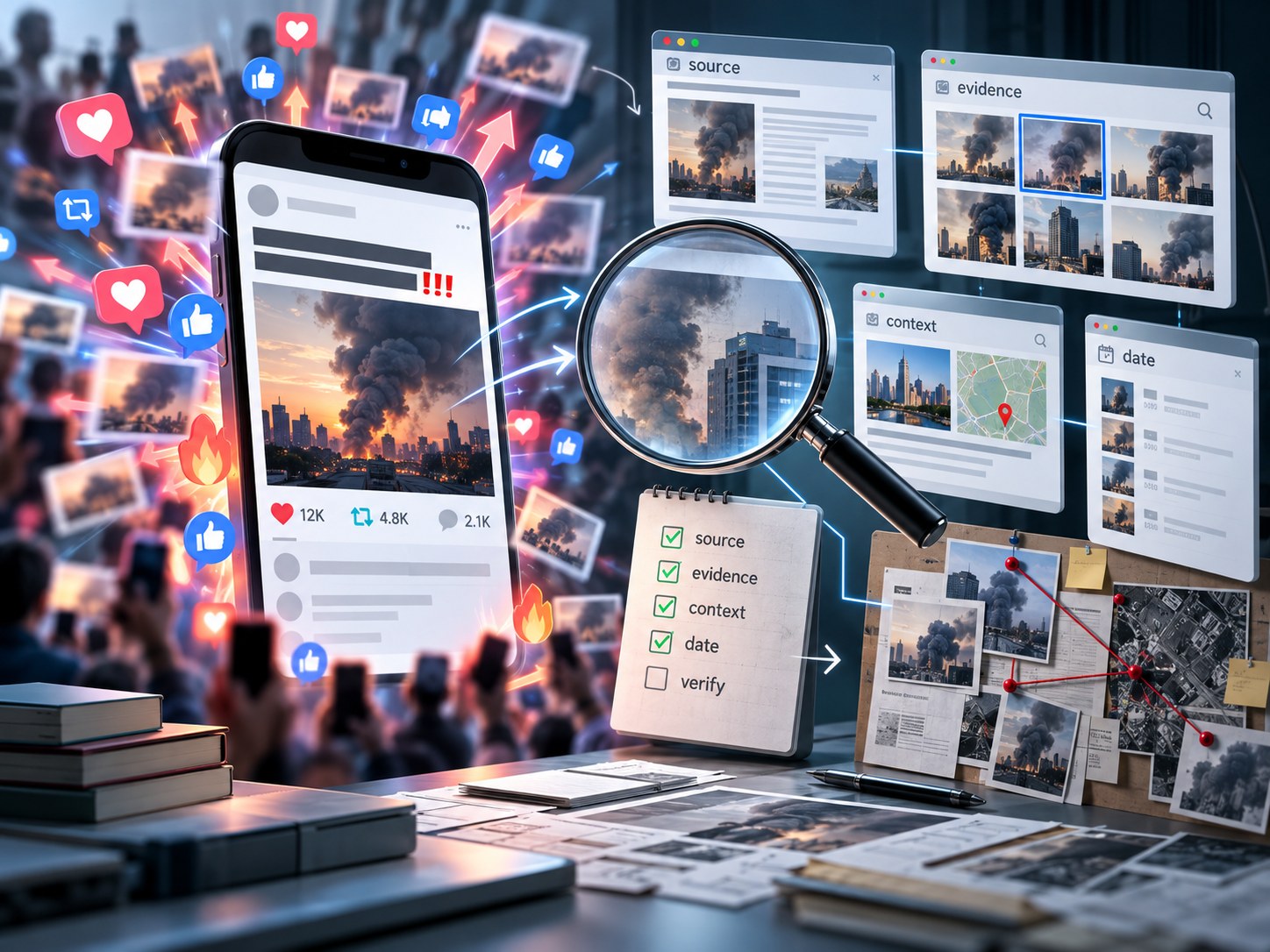
The short version
- Start by rewriting the viral post as one precise, checkable claim. A real photo, quote or video can still be attached to a false caption or exaggerated conclusion.
- Trace the claim backward to the earliest meaningful source and the underlying evidence. A repost, screenshot or article that merely cites another post is a carrier, not independent proof.
- Investigate unfamiliar sources laterally: leave the page, check who is behind it, and see what reliable sources say about its reputation and the claim.
- Test the evidence in the form it actually takes. Reverse-search images, inspect video keyframes, open the full transcript, find the original dataset and check dates, locations, denominators and methodology.
- Count independent reporting paths, not the number of accounts repeating the story. Finish with a proportional verdict such as supported, misleading, unsupported, false or unresolved.
The post is not the claim
A viral post can contain a genuine video and still be wrong.
The footage may be real but three years old. The quote may be accurate but clipped before the sentence that changes its meaning. A chart may reproduce real numbers while hiding the denominator. A screenshot may faithfully show what appeared on a screen without proving that the account, transaction or event behind it was genuine.
So the first question is not “Is this post fake?”
It is: What, exactly, is this post asking me to believe?
That distinction turns a vague credibility judgment into something you can actually investigate.
Professional verification teams work this way because digital evidence has layers. AP says its journalists corroborate facts with documents and on-the-record sources while checking visual material for metadata, timing and location. AFP describes a similar process, tracing images, video, comments and data back to original records and cross-checking the central claim with independent evidence.
The useful unit is the claim, not the vibe of the account sharing it.
1. Rewrite the claim in one sentence
Strip away the caption, reaction text, emojis and speculation.
Write the factual assertion as narrowly as possible:
A video posted on Saturday shows [event] happening in [place] on [date].
That sentence contains several separate things you can test:
- does the video show the claimed event?
- was it recorded in the claimed place?
- was it recorded when the post says it was?
- does the footage support the conclusion attached to it?
Do the same with statistics and quotes.
“Crime is up 40%” is incomplete until you know which crime, where, compared with what period, measured by whom and from what baseline.
“Person X said Y” should become a search for the original recording, transcript, interview, speech or post — not a search for screenshots repeating the quotation.
If a viral post makes five factual claims, split them into five lines. One may be true while the others are not.
2. Check whether somebody has already done the work
Before starting a full investigation, search the distinctive wording of the claim.
Try:
- a normal web search using the most unusual phrase in quotation marks;
- the names, location and date together;
- Google Fact Check Explorer, which indexes published fact checks and also supports image-based searches.
This is triage, not a verdict.
Finding a reputable fact check can save time because it may already link to the original document, full video or authoritative record. Finding nothing does not mean the claim is true. It may simply be new, obscure, local or worded differently.
The point is to learn what already exists before recreating the investigation from zero.
3. Trace the claim backward until you hit evidence
Most viral information reaches you several steps removed from its origin.
A typical chain looks like this:
viral account → screenshot → aggregation site → news article → local report → original document or eyewitness
Every step can change the wording.
The goal is not necessarily to find the oldest post on the internet. It is to find the earliest source that actually knows something.
Ask of each link:
- Did this source witness the event?
- Does it possess the document, data or recording?
- Is it quoting somebody who does?
- Or is it simply repeating another post?
That creates a useful distinction between a source and a carrier.
A screenshot of a news headline is a carrier. The article may be a carrier too if it cites another outlet. The strongest evidence may be a court filing, company statement, full interview, original dataset, eyewitness video or reporter who was physically present.
If the original post could disappear, preserve the URL, timestamp and surrounding context. AFP says its fact-checking teams use archives such as the Wayback Machine and Perma.cc both to preserve questionable claims and to retain evidence that may later change or vanish.
For screenshots specifically, the crop is only the beginning of the evidence problem.
4. Investigate the source by leaving it
A polished website can tell you surprisingly little about whether it deserves trust.
Professional fact-checkers often use lateral reading: instead of staying on an unfamiliar page and studying its design, biography and citations, they open new tabs and investigate the publisher from the outside.
In a study of 10 professional fact-checkers, 10 PhD historians and 25 Stanford undergraduates, the fact-checkers were more likely to leave unfamiliar sites, search for outside information about them and reach more warranted conclusions faster. The researchers called the behaviour lateral reading.
For an unfamiliar source, check:
- who owns or operates it;
- whether the author is identifiable;
- whether the person has relevant expertise or firsthand access;
- whether other credible sources describe the organization as reliable, partisan, satirical, promotional or repeatedly inaccurate;
- whether there is an obvious financial or political conflict;
- whether the source has corrected previous errors.
Do not turn reputation into a shortcut. A normally reliable outlet can make a mistake, and an unreliable account can occasionally post something true.
Source reputation changes how much evidence you demand. It does not replace the evidence.
5. Test the evidence in the form it actually takes
Different claims fail in different ways.
| Evidence | First useful checks |
|---|---|
| Photo | Find earlier appearances, the original upload and a wider/uncropped version; compare claimed date and place |
| Video | Find the full clip, extract or inspect keyframes, reverse-search frames, compare landmarks, weather, language and timing |
| Screenshot | Locate the original page/post/account; check what the crop excludes and whether the underlying record can be verified |
| Quote | Find the recording, transcript, interview or original post and read what comes immediately before and after |
| Statistic | Find the original dataset or study; check denominator, geography, date range, sample and methodology |
| Chart | Verify the underlying data, axis, units, baseline and whether the visualization omits relevant periods |
| Breaking event | Seek direct records, on-the-ground reporting, official information where appropriate and independent eyewitness material |
For images, Google Lens can surface similar images and pages where the same or similar material appears. Google’s About this image can sometimes show earlier web appearances, which is useful when an old image is being presented as new.
For video, AFP describes extracting keyframes and reverse-searching those still images to find older or fuller versions of footage. AP lists reverse-image search, geolocation and frame-by-frame inspection among the checks used on user-generated content.
Reuters’ visual-verification team also compares material with outside evidence such as metadata and weather information, and may contact the creator directly. That is the larger lesson: do not ask one clue to carry the entire verdict.
The same applies to AI detectors. AFP explicitly says it does not use an AI-detection result as sufficient evidence on its own. Detector output can be a lead. It is not provenance.
6. Count independent reporting paths, not logos
A claim repeated by 20 accounts can still have one source.
This happens constantly during breaking news:
- one account posts an allegation;
- several aggregators copy it;
- articles report that “social media users say” it happened;
- more accounts cite those articles as confirmation.
The circle now looks large. The evidence has not grown.
When looking for corroboration, ask whether each source has a separate path to the fact.
Two outlets both citing the same anonymous Telegram post are not two independent confirmations. Two reporters speaking to different eyewitnesses may be. A company statement plus a regulator filing may be. Two articles that both trace back to the same press release are not.
AFP says it requires at least two independent sources of information to verify the central claim of a fact check. That is a useful discipline even when you are not running a newsroom.
Count evidence chains, not tabs.
7. Audit what is missing
Some of the strongest misinformation is built from real material.
Nothing needs to be fabricated if the post can simply remove the part that changes the meaning.
Before deciding, ask:
- Is the date visible?
- Is the location established?
- Is this the full quote?
- What happened immediately before or after the clip?
- Does the statistic use the expected denominator?
- Is the chart showing absolute numbers or percentages?
- Is a temporary spike being described as a long-term trend?
- Is a prediction being repeated as if it already happened?
- Is an allegation being described as a confirmed event?
- Is a screenshot being treated as proof of the underlying reality rather than proof of what appeared on a screen?
This is where a binary “real or fake” frame breaks down.
A genuine image with the wrong date is not a fake image. It is evidence being used misleadingly. A real quote cut out of a longer answer may be authentic and still create a false impression.
Audit the interpretation as aggressively as the file.
8. Give the claim only the verdict the evidence earns
Not every investigation ends cleanly.
A practical set of labels is:
| Verdict | What it means |
|---|---|
| Supported | The claim is backed by strong direct evidence and appropriate independent corroboration |
| Misleading / missing context | Some underlying material is genuine, but the framing, omission or inference materially changes what it means |
| Unsupported | The evidence presented does not establish the claim |
| False | Reliable evidence directly contradicts the claim |
| Unresolved | Available evidence is insufficient, inaccessible or genuinely conflicting |
The difference between unsupported and false matters.
If somebody posts “Company X has been acquired” with no evidence, your inability to confirm it does not prove no acquisition happened. The correct conclusion may simply be that the claim remains unverified.
AFP’s methodology makes the same restraint explicit: if its journalists cannot establish strong, cross-checked evidence, they do not publish a fact check.
Certainty is part of the reporting. Do not manufacture it because a clean verdict looks better.
A fast audit for everyday claims
For a low-stakes claim, five questions catch a surprising amount:
- What exactly is being claimed?
- Where did this specific claim come from?
- What is the best underlying evidence?
- What independent source confirms the same fact through a separate path?
- What important context would change the conclusion?
If you cannot answer questions two through four, do not promote the claim from “viral” to “verified.”
For health, financial, legal, election or public-safety claims, the threshold should be higher. Go to the relevant primary records and authoritative sources rather than treating a social-media audit as the final word.
Keep a tiny evidence ledger
A claim becomes much easier to revisit if you record the investigation while doing it.
Save:
- the exact wording you checked;
- the viral post URL and timestamp;
- the earliest meaningful source you found;
- the primary evidence;
- each genuinely independent corroborating source;
- any contradictory evidence;
- your verdict;
- what remains unknown.
This also makes corrections easier. If better evidence appears tomorrow, you can see exactly which part of the conclusion changed.
The workflow is simple to remember:
Follow the claim backward until you reach evidence. Then follow the evidence outward until you have independent corroboration.
Virality tells you that a claim travelled.
An audit tells you whether it deserved to.
Sources & reference material
- How we workAFP Fact Check · Accessed Oct 10, 2026
Professional fact-checking workflow covering source tracing, independent corroboration, reverse image search, video keyframes, archives, primary records and limits on AI-detection tools.
- Verification at APThe Associated Press · Accessed Oct 10, 2026
AP verification practices for documents, on-the-record sources, metadata, timing, location, reverse-image search, geolocation and user-generated content.
- What is visual verification and why does Reuters practice it?Reuters · Accessed Oct 10, 2026
Current newsroom visual-verification practices including creator contact, metadata review and comparison with weather and other external evidence.
- Fact Check ExplorerGoogle · Accessed Oct 10, 2026
Tool for searching published fact checks by topic, person and image.
- Search with an image on GoogleGoogle Search Help · Accessed Oct 10, 2026
Google Lens can search an uploaded image or image URL and return similar images and webpages containing the image or visually similar material.
- Learn more about an imageGoogle Search Help · Accessed Oct 10, 2026
About this image can surface earlier web appearances and contextual information, while Google cautions that associated metadata can be modified.
- Lateral Reading and the Nature of Expertise: Reading Less and Learning More When Evaluating Digital InformationTeachers College Record · Accessed Oct 10, 2026
Study comparing professional fact-checkers, historians and Stanford undergraduates; fact-checkers more often left unfamiliar sites to investigate them through other sources and reached more warranted conclusions faster.