
The short version
- Yes, a blue verification badge can still increase trust in some settings — especially trust that an account is authentic — but the effect is inconsistent and highly dependent on what the platform's badge actually means.
- Multiple experiments have found little or no badge effect on the perceived accuracy or credibility of individual posts; source reputation, prior beliefs and context often matter more.
- Influencer research is more favorable to verification: badges can raise perceived authenticity or trust, particularly when verification is selective rather than easily purchased.
- Paid verification weakens the old status signal. On X, a blue check now indicates Premium subscription eligibility rather than identity verification by default.
- A badge should change your confidence about account identity only to the extent that the platform actually verifies identity. It should not be treated as evidence that a specific claim is true.
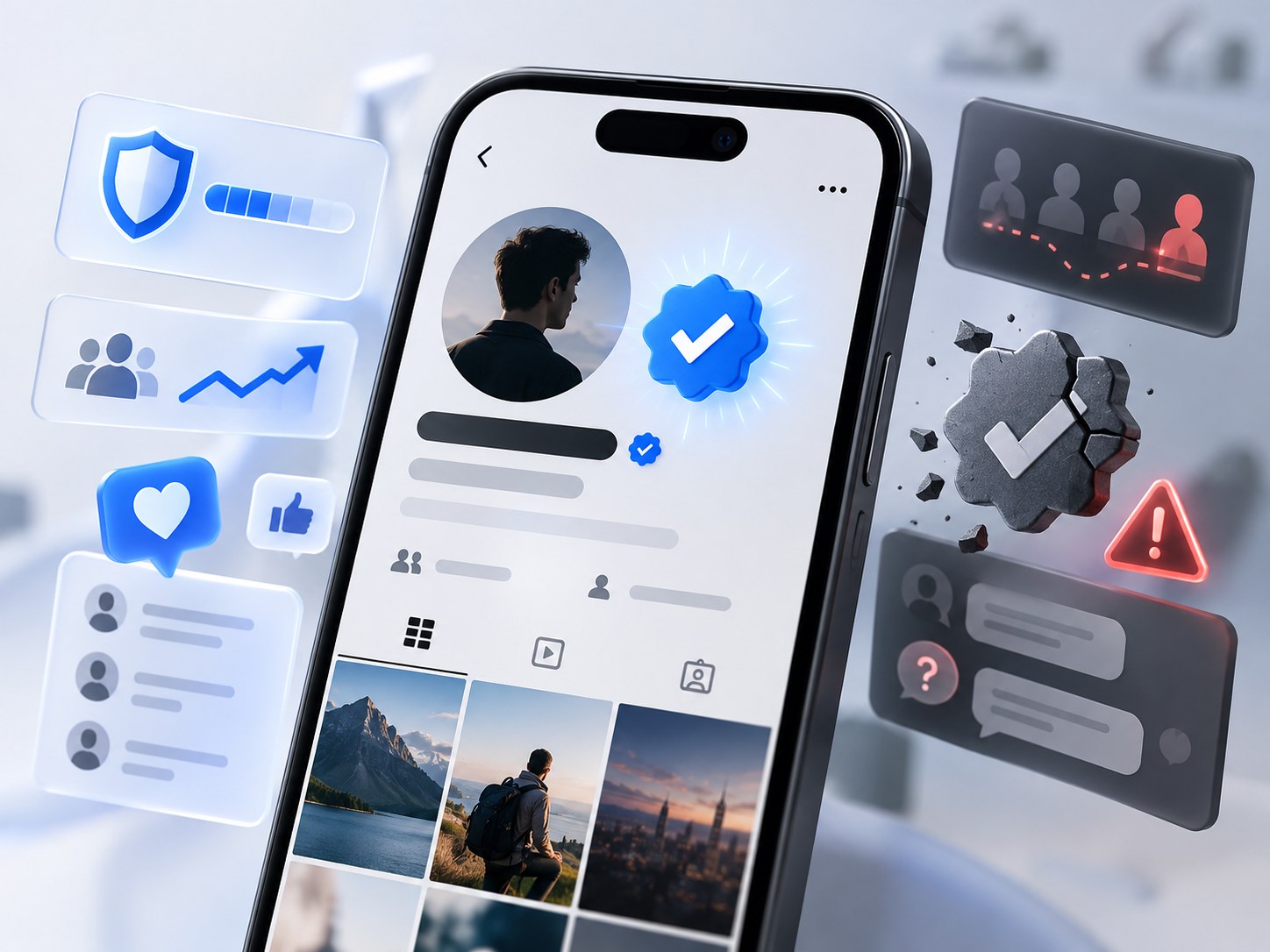
The blue check still does something. It just does not mean one thing anymore.
For years, the blue verification badge compressed several ideas into one tiny symbol.
This is really the person. They are notable enough for the platform to care. The platform has checked them.
Those ideas were never perfectly interchangeable, but they travelled together closely enough that the badge developed a reputation of its own.
In 2026, that shortcut is badly fractured.
On TikTok, the blue badge still means the platform has confirmed that the account belongs to the person, business or brand it represents. YouTube says its verification badge establishes that a channel is authentic. Instagram mixes older notable-account verification with the paid Meta Verified system. Facebook has started rolling out a separate free badge that uses selfie verification to confirm there is a real person behind a profile.
And on X, the meaning is fundamentally different. X now says its blue checkmark indicates an active Premium subscription and does not mean that the account has been ID verified.
So the useful question is no longer simply whether people trust the blue check.
It is whether a badge still transfers trust when the meaning behind it varies from identity check to notability signal to subscription feature.
The research gives a messy but useful answer:
A verification badge can still increase perceived authenticity or trust in some contexts. It does not reliably make the content underneath it seem more accurate, and its power weakens when the badge becomes easy to buy.
Account authenticity and content credibility are different questions
This distinction explains much of the apparently contradictory research.
A badge can answer:
Is this really the account it claims to be?
It cannot automatically answer:
Is this account correct about the thing it just posted?
That sounds obvious when written out. In a feed, people do not always keep the two judgments separate.
A 2024 PLOS ONE paper ran two preregistered experiments with 525 and 590 participants. The researchers tested identity-verification badges and more specific credential badges on posts from unknown authors. In a Twitter-like medical context, verification could raise perceived source and message credibility. But the broader pattern was inconsistent, and once participants were taught what the badges represented, another problem appeared: people sometimes treated verified identity or credentials as a reason to believe the message itself.
The authors called one version of this a “virtual lab coat” effect. A verified credential could lend authority even when the credential was not relevant to the claim being judged.
That is the basic danger of a trust badge. A legitimate signal about who someone is can spill over into a much larger conclusion about whether what they say is true.
Several experiments find almost no blue-check credibility boost
The strongest reason not to treat verification as a universal trust machine is simple: in multiple controlled studies, adding the badge did very little.
A 2019 experiment on Twitter news accounts found that participants paid little attention to the verification mark when judging account and information credibility. Account ambiguity and political congruence mattered more than the badge.
A later Instagram experiment reached a similar result. Across two studies with 963 participants, researchers varied the source of a climate-change post, whether it carried a verification label and how the accompanying image was produced. The identity of the source affected credibility; the verification label did not.
A 2024 random-assignment experiment involving 534 adult social-media users in Florida tested vaccine posts from medical experts with and without verification badges. The badge did not significantly change perceived accuracy, willingness to repost or willingness to follow the author.
These studies are not proof that badges never matter. They are evidence against the much stronger idea that putting a blue check beside a name reliably makes the information below it more believable.
In some situations, readers seem to route around the badge almost entirely.
They look at the source. The topic. Their prior beliefs. The account’s reputation. The post itself.
The little blue icon loses.
Influencer research finds a stronger trust effect
Move from news credibility to influencer marketing and the badge starts doing more work.
A 2024 study in the Journal of Research in Interactive Marketing ran three experiments around Instagram influencers. The researchers found that a verified badge could increase trust, which then improved attitudes and sharing intentions. The trust effect was stronger for micro-influencers than for macro-influencers.
That makes intuitive sense.
A giant celebrity account already arrives with many other cues: fame, follower count, media coverage, familiar face, known brand. Verification may add little.
For a smaller creator, the badge can carry more informational weight. It fills in a blank.
But even influencer verification is not a clean “blue check = trust” story.
A 2022 Journal of Consumer Behaviour paper found that consumers associated verification more closely with celebrity than authenticity. When an influencer promoted a product that did not fit their established image, participants were actually less likely to trust the verified account than the unverified one.
The badge made the influencer look more prominent. It did not protect them from a bad endorsement.
This is the same pattern we see with other visible social metrics. A signal can change the frame around an account without independently validating every claim it makes. Follower counts and analytics work similarly: they tell you something about the account, but not necessarily what the account wants you to infer from them.
Paid verification changed the signal
The original blue check was powerful partly because it was scarce.
Not everyone could get one. The platform decided who qualified. That selectivity allowed the badge to accumulate secondary meanings beyond simple identity: importance, public interest, access, status.
Once the same visual object can be purchased, its economics change.
A 2026 Journal of Business Research study is unusually useful here because it examines verification under different policy regimes rather than treating all blue badges as equivalent. The project combined influencer interviews, consumer discussion, a controlled experiment and more than eight million daily observations from X.
Its conclusion is more precise than “paid checks are useless.”
Verification continued to raise perceived authenticity. But as the badge became easier to obtain, its ability to signal influence weakened. Under fully paid verification, that influence effect reversed, reducing the badge’s ability to drive engagement.
In other words:
People can still read a badge as “this account is more authentic-looking” while no longer reading it as “this account is important.”
That is exactly what signaling theory would predict when an exclusive signal becomes widely available.
The icon stays the same.
The cost of obtaining it changes.
The audience learns.
The meaning decays.
X is the clearest example of why the platform now matters
On legacy Twitter, the blue check was awarded under criteria built around authenticity, notability and activity.
That system ended.
X’s current documentation says the standard blue check now means the account has an active Premium subscription and meets eligibility requirements. It explicitly says the blue check does not mean the account has been ID verified. ID verification is a separate optional process.
That difference became a regulatory issue in Europe.
In December 2025, the European Commission fined X €120 million for several Digital Services Act violations, including what it called the deceptive design of the blue check. The Commission argued that users could pay for the “verified” status without X meaningfully verifying who was behind the account.
X disputes that decision and is appealing it. Its help material now makes the distinction unusually explicit, including stating that users in the European Economic Area may see blue-check accounts described as Premium rather than verified.
So on X, using the badge itself as evidence of identity is a category error unless you inspect the account’s additional verification information.
The blue check still signals something.
It just signals subscription status plus platform eligibility, not the old verification claim.
A blue badge means different things on different platforms
That fragmentation matters more than the color.
| Platform / badge | What the platform currently says it establishes | What it does not establish |
|---|---|---|
| X blue check | Active Premium or Premium+ subscription plus eligibility review | ID verification by default; expertise; truthfulness |
| Instagram verified badge | Account verification based on activity and information/documents; badge may come from traditional verification or Meta Verified | That the account’s posts are accurate or endorsed by Meta |
| Facebook Verified | A real person completed selfie-based verification and meets trust-and-safety eligibility | Endorsement or a guarantee that the person is trustworthy |
| TikTok verified badge | TikTok confirmed the account belongs to the person, business or brand it represents; current system is not sold by TikTok | Endorsement; accuracy of a particular post |
| YouTube verification badge | YouTube verified that the channel is authentic | Award, milestone, endorsement or factual accuracy |
That means a reader cannot correctly interpret the symbol without knowing the platform’s policy.
This is a broader problem in portable online identity: interfaces often make identity feel standardized even when the underlying systems are not. Two profiles can carry nearly identical visual authority cues while having passed very different checks.
Meta itself now demonstrates the split. Instagram can show a paid Meta Verified badge, while Facebook announced a separate free Facebook Verified program in July 2026 that uses a video selfie to confirm a real person. Meta explicitly says the latter does not guarantee trustworthiness.
That disclaimer is worth keeping.
Verified person is not the same category as trustworthy person.
Why the badge can still work even when people know it is imperfect
Trust cues do not need to be logically decisive to influence perception.
A badge is immediate. It sits beside the name. It repeats across every post. It resembles other certification marks people encounter in payments, security and identity systems.
It also carries history.
Someone who learned that “blue check = verified public figure” years ago does not necessarily rebuild that mental model every time a platform changes its policy. Interface meaning can lag behind policy meaning.
The 2026 verification study suggests consumers do notice policy shifts, but the authenticity association does not disappear instantly. That leaves a residue of the old signal even when its exclusivity declines.
The effect is probably strongest when the user has little other information.
A familiar news organization does not need a badge to tell you what it is. A stranger with 3,000 followers might benefit much more from the same symbol.
That is consistent with the Instagram influencer research, where the badge’s trust effect was stronger for micro-influencers.
Verification is therefore best understood as a heuristic: a fast cue that can shape an initial impression when better evidence is absent.
Heuristics are useful.
They are also easy to overextend.
What should a blue check actually change in your judgment?
The most defensible approach is to narrow the inference.
If a platform’s verification process genuinely checks identity, the badge should increase your confidence that the account belongs to the person or organization it claims to represent.
That is valuable. Impersonation is a real problem.
But the confidence should stop there.
A verified doctor can make a bad medical claim. A verified founder can exaggerate revenue. A verified journalist can post something before it is confirmed. A verified celebrity can promote a terrible product. A Premium subscriber on X may not have had their identity checked at all.
The badge does not replace evidence.
When the claim matters, inspect what supports the claim: primary documents, direct data, relevant credentials, corroborating sources, full context. Verification can help establish provenance. It cannot manufacture truth.
That is also why visible metrics should be read cautiously. As with creator analytics or the status cues behind online displays of wealth, a number or symbol can be genuinely attached to an account while the conclusion drawn from it is still too large.
So: does the blue badge still increase trust?
Sometimes.
The evidence supports a narrower answer than either side of the verification debate usually wants.
Blue badges can raise perceived authenticity or trust, especially for lesser-known accounts and in contexts where the badge still represents meaningful authentication.
But experimental research repeatedly finds that the badge may have little effect on whether people believe a specific post. Source identity, political alignment, expertise, context and the content itself can matter more.
And the move toward paid verification has weakened the old status value of the symbol.
There is no longer one universal “blue check” to trust.
There are several visually similar badges backed by different rules.
That makes the policy behind the icon more important than the icon itself.
A useful rule is:
Trust the badge only for the thing the platform actually verified.
If the platform verified identity, treat it as an identity signal.
If it verified a subscription, treat it as a subscription signal.
Anything beyond that still needs evidence.
Sources & reference material
- The Blue Check of Credibility: Does Account Verification Matter When Evaluating News on Twitter?Cyberpsychology, Behavior, and Social Networking / PubMed · Accessed Oct 10, 2026
Experimental study finding that Twitter verification drew little attention and did not meaningfully improve credibility judgments of news accounts or their information.
- Does the verified badge of social media matter? The perspective of trust transfer theoryJournal of Research in Interactive Marketing / National Taipei University · Accessed Oct 10, 2026
Three experiments finding that an Instagram verification badge could increase follower trust, attitude and sharing intentions, with a stronger trust effect for micro-influencers.
- The credibility cocktail on Instagram: Assessing the impact of source, verification label and image manipulation on news message credibilityAfrican Journalism Studies / Intellect · Accessed Oct 10, 2026
Two experiments with 963 participants finding that source identity affected credibility judgments while the Instagram verification label itself did not.
- Social Media Authentication and Users’ Assessments of Health Information: Random Assignment Survey ExperimentJMIR Formative Research · Accessed Oct 10, 2026
Random-assignment experiment with 534 adult social-media users finding no significant verification-badge effect on perceived accuracy, reposting intention or willingness to follow medical experts.
- Virtual lab coats: The effects of verified source information on social media post credibilityPLOS ONE · Accessed Oct 10, 2026
Two preregistered experiments showing that verification cues can sometimes increase source and message credibility, while also encouraging people to confuse source authenticity or credentials with message credibility.
- When influencers are not very influential: The negative effects of social media verificationJournal of Consumer Behaviour · Accessed Oct 10, 2026
Two studies finding that consumers associated influencer verification more closely with celebrity than authenticity and that verification could reduce trust when an endorsement poorly matched the influencer.
- The impact of platform verification badges on social media influencer engagementJournal of Business Research · Accessed Oct 10, 2026
Multimethod research including an experiment and more than eight million daily observations from X finding that easier or paid verification weakens the badge's influence signal even when some authenticity signal remains.
- About X Blue CheckmarkX Help Center · Accessed Oct 10, 2026
Current X documentation stating that a blue checkmark indicates an active Premium subscription and does not by itself mean the account has been ID verified.
- Commission fines X €120 million under the Digital Services ActEuropean Commission · Accessed Oct 10, 2026
European Commission decision finding X's blue-check design deceptive because users could pay for the status without meaningful verification of who was behind the account.
- What happens when you apply for a verified badge on InstagramMeta / Facebook Help Center · Accessed Oct 10, 2026
Meta documentation explaining that Instagram verified badges can belong either to notable accounts or Meta Verified subscribers and are based on account activity plus information or documents provided.
- Introducing Facebook VerifiedMeta · Accessed Oct 10, 2026
Meta announcement of a free Facebook Verified badge using selfie-based verification, explicitly stating that the badge confirms a real person but does not guarantee trustworthiness or endorsement.
- Verified accounts on TikTokTikTok Support · Accessed Oct 10, 2026
TikTok documentation stating that its badge confirms an account belongs to the represented person or brand, is not sold by TikTok and does not imply endorsement.
- Verification badges on channelsYouTube Help · Accessed Oct 10, 2026
YouTube documentation stating that its channel badge confirms the channel is authentic while explicitly noting that verification is not an endorsement, award or milestone.