
The short version
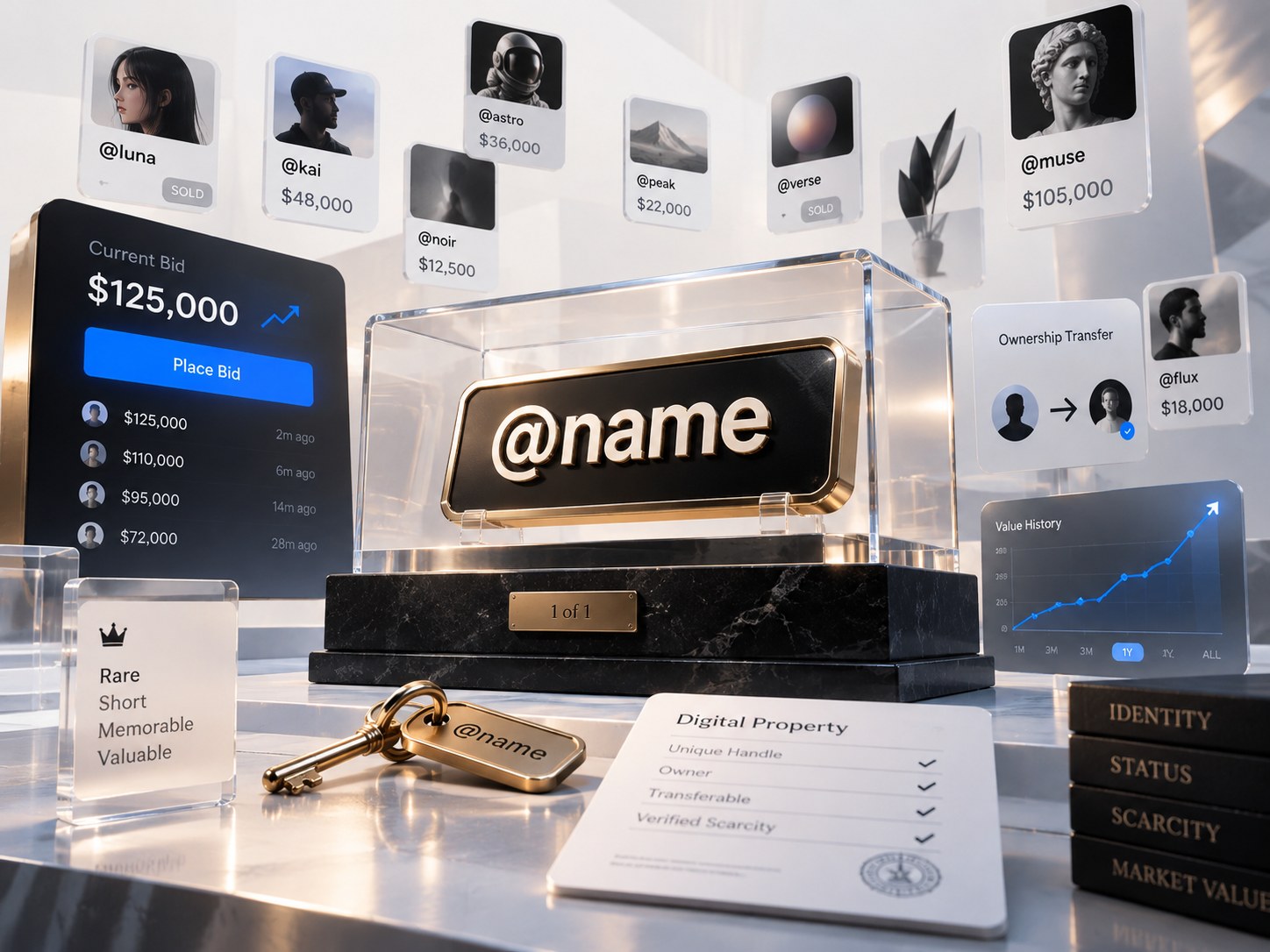
- A handle is valuable because one short string can combine identity, search, linking, word-of-mouth discovery and brand recognition inside a large network.
- Scarcity matters, but demand matters more: X now says commercial value, rarity, demand and market dynamics can push official handle-transfer fees from five figures into seven figures.
- The word "asset" needs qualification. X explicitly says users receive a revocable license rather than ownership, while Telegram collectible usernames are designed to be bought and sold.
- Platform rules are part of the valuation. A rare name can be commercially useful and still be reclaimable, non-transferable or risky to acquire outside official systems.
A username stopped being just a login name
In January 2014, developer Naoki Hiroshima wrote that people had offered him as much as $50,000 for his one-letter Twitter username, @N. The name was valuable enough that an attacker ultimately targeted it in an extortion scheme. Hiroshima’s account, republished by Ars Technica, made a strange corner of internet economics visible: a string of characters that cost nothing to register could become worth real money once millions of people wanted the same namespace.
At the time, a $50,000 social-media username sounded like an internet oddity.
It does not anymore.
X now operates an official Handle Marketplace. The company says some higher-value handles require a transfer price based on commercial value, rarity, demand and market dynamics, with typical fees starting in the five-figure range and extending into seven figures.
Telegram went in a different direction. Its collectible usernames can be bought and sold through Fragment, attached to accounts or public chats, found in Global Search and reached through their own t.me links.
WhatsApp has now joined the land rush too. In June 2026, it opened username reservations before the feature’s wider rollout, explicitly noting that with more than three billion users, a lot of desirable names overlap. It also created a path for some creators, businesses and organizations to claim the same username they already use on Instagram or Facebook.
The username has evolved from a login label into something closer to digital frontage.
Not because the characters themselves are magical.
Because of what the characters can route.
The handle is a tiny piece of infrastructure
A good handle can do several jobs at once.
It is an identifier in search. It is a mention other users can type. It is part of a profile URL. It is something a person can say aloud in a video, print on packaging, put in an ad or remember after seeing it once.
On a large platform, that makes the handle a routing layer between attention and identity.
| What the handle does | Why that can create value |
|---|---|
| Identifies an account | Makes one exact string point to one person, brand or community |
| Appears in search and mentions | Reduces friction when people try to find or tag the account |
| Forms part of a public link | Turns the name into an address that can circulate outside the app |
| Repeats across posts and media | Builds recognition around the string over time |
| Matches a real name or brand | Removes qualifiers, extra punctuation and confusing alternatives |
| Matches other platforms | Makes the same identity easier to recognize across networks |
This is why a handle can be worth money even when it carries no followers with it.
X’s marketplace makes that separation unusually clear. When an approved handle is moved onto an account, the account’s followers, posts, DMs and settings remain unaffected. The handle is treated as a distinct resource that can be reassigned without moving the social graph attached to the account.
That is a more useful way to think about the market than “people pay for cool usernames.”
They are paying for a clean address inside an important network.
Scarcity starts the market. Demand sets the price.
Every platform username system creates scarcity by design.
There can only be one exact @name in a given namespace at a time. Once @alex, @cars, @ai or another obvious string is taken, the next user has to modify it, wait for it to become available or use something else.
Short names become scarce fastest simply because there are fewer possible combinations. Real words, common first names and category terms add another layer because many unrelated people or companies may want the same string.
But scarcity alone is not enough.
A random three-character username can be mathematically rare and commercially useless. A longer word can be more valuable because it maps perfectly to a company, product, category or public identity.
X’s own pricing language captures the distinction. Its marketplace does not say short handles are expensive merely because they are short. It cites commercial value alongside rarity, demand and market dynamics.
The platform matters too.
The exact same string can have radically different value on a network with a billion active users than on a service nobody uses anymore. A username is scarce inside a particular system, so its value depends partly on how much attention that system can route.
WhatsApp’s 2026 rollout shows the problem at enormous scale. The company opened reservations early because more than three billion users inevitably create collisions around common names. The product decision itself is an admission of scarcity: unique identifiers become contested when the network is large enough.
Consistency across platforms became part of the asset
For a creator or business, the ideal is often boring:
@name on everything.
No extra underscore on one platform. No official suffix on another. No unexplained number because somebody registered the obvious version ten years earlier.
That consistency has practical value. A person who sees a name on Instagram can search the same string on another service. A brand can put one handle into an ad without explaining five variants. An audience has fewer opportunities to land on an impersonator or an unrelated account.
WhatsApp is now explicitly supporting this idea by allowing some creators, businesses and organizations to reserve their existing Instagram or Facebook username. The product is not merely assigning a new contact label. It is treating cross-platform identity continuity as useful enough to build into the reservation system.
This connects to a larger distinction in online identity. As our piece on portable online identity explains, the readable name people recognize does not have to be the same thing as the stable identifier a system uses underneath.
The public handle is the human layer.
That human layer can accumulate enormous value even when the technical account beneath it is replaceable.
Reputation sticks to names
A new username begins as an empty string.
Then people see it attached to posts, videos, replies, screenshots, products, communities and links. The name gets repeated. Other people type it. Search engines index it. Fans remember it. Journalists cite it. Friends recommend it.
Eventually, changing the string has a cost.
X warns users preparing for a handle change that a new handle may confuse followers and that old tags or links can break. That is a small operational note with a bigger implication: identity becomes path-dependent.
A name that has circulated for years is not equivalent to a fresh replacement, even if both lead to the same account today.
This does not mean the username itself owns the reputation. The content, person or company creates the reputation.
But the handle becomes one of the main labels through which that reputation is retrieved.
That is why a short, exact name can behave less like decoration and more like a brand asset.
Platforms are finally monetizing the scarcity they created
For most of social-media history, platforms created unique namespaces but did not provide a clean market for reallocating valuable names.
That gap produced predictable tension.
Users held dormant names. Brands wanted exact names. Early adopters controlled unusually scarce strings. Informal brokers and secondary markets appeared. So did squatting disputes, theft attempts and account-recovery nightmares.
The @N case was an extreme example of what happens when a valuable identifier exists without a legitimate transfer system that matches the value people assign to it.
The newer systems are attempts to formalize that demand.
X: expensive access, not ownership
X’s marketplace can charge a transfer price for select handles, but its legal terms are unusually explicit: the recipient receives a limited, revocable and non-transferable right to use the handle.
X retains ownership.
The company can reclaim a marketplace handle, and users cannot resell or transfer it to a third party. In other words, a buyer may pay an enormous amount for the right to use a scarce identifier without acquiring the kind of property right the word “buy” usually implies.
Telegram: usernames designed to be traded
Telegram’s collectible usernames use a different model.
Telegram says ownership is secured by TON and the usernames can be bought and sold through Fragment. The same collectible can still perform ordinary username functions: it appears in search and can resolve through a public Telegram link.
That makes the asset analogy much more literal.
TikTok: a valuable name can still be reclaimed
TikTok’s current U.S. Terms of Service show the other end of the spectrum. Users may not transfer an account without permission, and TikTok says it may revoke, reclaim or reassign a username in circumstances including 180 days without logging in, an account ban or policy and rights violations.
A name can therefore be economically desirable without being securely ownable.
That distinction matters.
“Digital asset” is economically useful shorthand, not one legal category
Calling a username a digital asset makes intuitive sense.
It can be scarce. It can attract bids. It can lower branding friction. It can route attention. It can be stolen or fought over. Some platforms now attach explicit prices to it.
But the phrase becomes misleading if it implies the same ownership rights everywhere.
| Platform model | What the user actually has |
|---|---|
| X Handle Marketplace | A limited, revocable, non-transferable license to use the handle; X retains ownership |
| Telegram collectible username | A transferable collectible username whose ownership is secured through TON and which can be bought or sold on Fragment |
| TikTok username | An account identifier subject to platform rules and possible reclamation or reassignment |
| WhatsApp username | A unique identifier being rolled out and reserved within WhatsApp’s platform-controlled system |
The economic value is real.
The property right is platform-specific.
That is one of the strangest features of internet assets: people can rationally value something they do not fully control.
A business can spend money building recognition around a social handle while the underlying platform still writes the rules for whether that handle can be transferred, reclaimed or kept indefinitely.
What actually makes a username valuable
There is no universal price formula, but the strongest handles tend to combine several of the same characteristics.
Exactness
@brand is usually cleaner than @brand_official_26.
Exact names reduce explanation and look more authoritative because they map directly to the identity people already know.
Brevity
Short strings are easier to type, say and remember. They are also mechanically scarcer.
Brevity matters most when the short name still has meaning.
Meaning
A dictionary word, common name, category term or strong brand word can have a much deeper buyer pool than an equally short random string.
Scarcity creates the ceiling. Meaning creates demand.
Platform relevance
A perfect handle on a declining network is less useful than a slightly worse handle on the network where the audience actually is.
The value comes from the connection between the name and the distribution system behind it.
Cross-platform fit
A name becomes more useful when the same string can anchor a recognizable identity across multiple services.
WhatsApp’s decision to help some users carry over an Instagram or Facebook username is a direct product example of that value.
Policy and transferability
A handle that can be legitimately transferred through a platform-controlled system is fundamentally different from one that can only change hands through a transaction the platform may prohibit.
Transfer rules do not merely create legal fine print.
They change what the asset actually is.
The most valuable part is not the string
A username is only a few bytes of text.
Its value comes from the system around it.
A short handle on an empty database is nothing. Put the same handle inside a network used by hundreds of millions or billions of people, make it searchable, mentionable and linkable, then let years of culture and commerce accumulate around that namespace, and the economics change.
The platform creates the scarcity.
The audience creates the demand.
The person or brand creates the reputation.
The handle compresses all three into one public label.
That is why usernames became valuable digital assets.
And it is also why the most important question is not simply “What is this handle worth?”
It is:
What, exactly, does the platform let you own?
Sources & reference material
- X Handle MarketplaceX Help Center · Accessed Oct 10, 2026
Current rules for X's Handle Marketplace, including transfer pricing, pricing factors, handle changes, licensing and restrictions on resale.
- X Handle Marketplace TermsX Corp. · Accessed Oct 10, 2026
Primary terms stating that transferred X handles are licensed rather than owned and remain revocable and non-transferable.
- Topics in Groups, Collectible Usernames, Voice-to-Text for Video Messages and MoreTelegram · Accessed Oct 10, 2026
Primary announcement that Telegram collectible usernames can be bought and sold, appear in Global Search and use public t.me links.
- It's time to reserve your WhatsApp usernameWhatsApp · Accessed Oct 10, 2026
Primary announcement of WhatsApp username reservations, the three-billion-user scale behind name collisions and cross-Meta username claiming for eligible creators, businesses and organizations.
- Terms of ServiceTikTok · Accessed Oct 10, 2026
Current U.S. terms stating that accounts cannot be transferred without permission and usernames may be revoked, reclaimed or reassigned in specified circumstances.
- How I lost my $50,000 Twitter usernameArs Technica · Accessed Oct 10, 2026
First-person account by Naoki Hiroshima describing a $50,000 offer for @N and the extortion attempt that targeted the handle.