
The short version
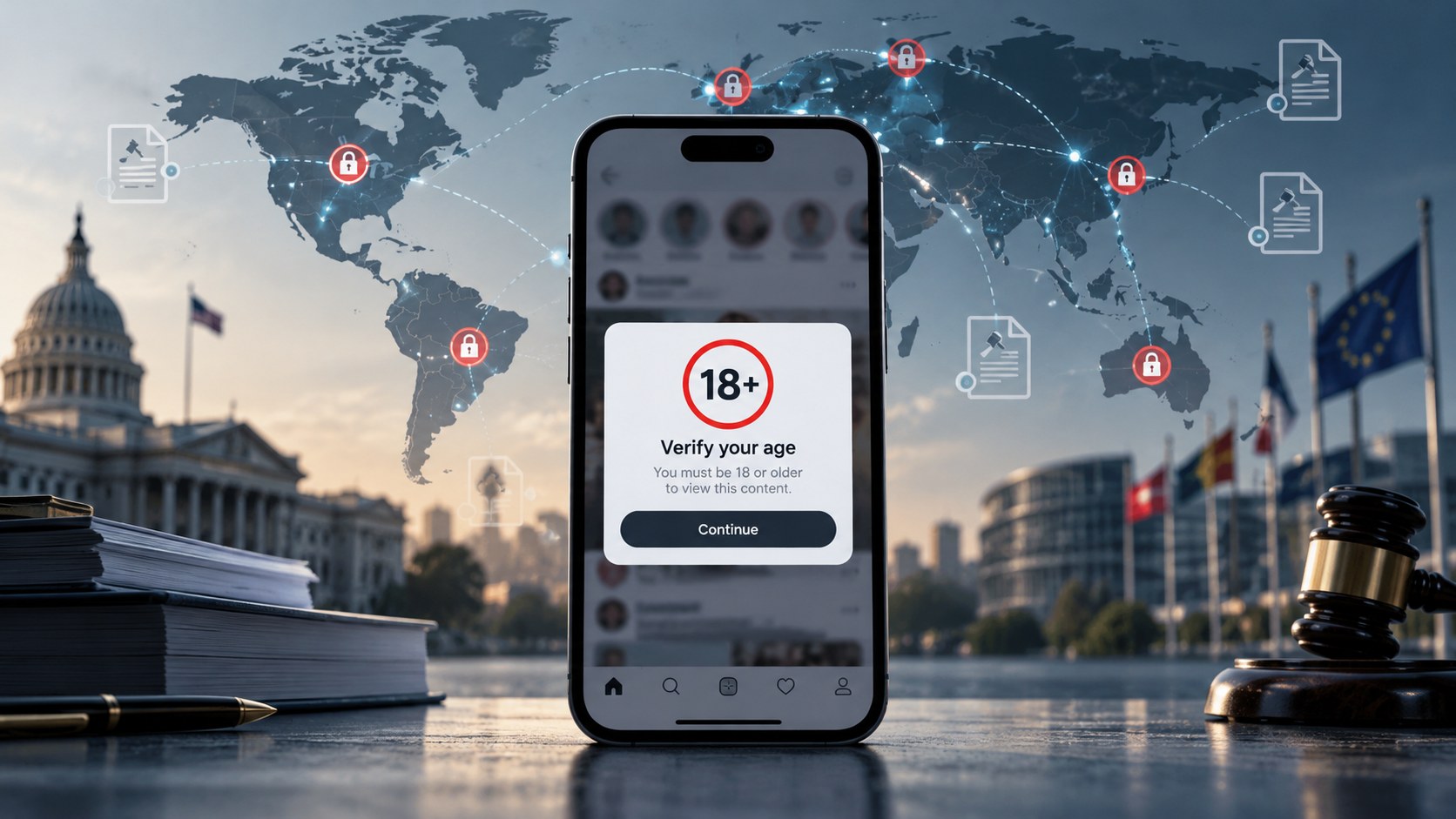
- There is no single global “under-15 social media ban.” The thresholds, services covered and legal status differ sharply by country.
- Australia has the clearest live model: since 10 December 2025, covered platforms must take reasonable steps to stop Australians under 16 from creating or keeping accounts.
- France passed a broad under-15 ban in July 2026, but its Constitutional Council struck the ban down in August as disproportionate and inadequately protective of privacy.
- The EU has proposed a minimum age of 15 for an independent account, while the UK, Canada, Norway and Spain are pursuing versions centred around age 16.
- The hardest part is not choosing 15 or 16. It is building age checks that actually work without turning every adult's social-media login into an unnecessary identity check.
There is no single “social media ban for under-15s”
The headline is spreading faster than the law.
Governments are converging on the same basic idea — young teenagers should not get unrestricted social-media accounts simply because they typed a believable birthday — but they are not converging on one rule.
Australia already has an under-16 account restriction in force. France passed an under-15 ban and then had the core measure struck down by its Constitutional Council. The European Commission has proposed a graduated system that blocks access below 13 and sets 15 as the minimum age for an independent account. The UK and Canada are pursuing under-16 restrictions. Norway and Spain are moving in roughly the same direction.
Those differences matter because “ban” can mean at least four different things:
- no account at all;
- no independent account without a parent;
- access allowed, but risky features disabled;
- or a platform obligation to keep underage users out rather than a penalty on the child.
As of 10 October 2026, this is the cleaner picture.
| Jurisdiction | Age line | Status | What it actually means |
|---|---|---|---|
| Australia | 16 | In force | Covered platforms must take reasonable steps to stop under-16s from creating or keeping accounts. |
| European Union | 13 / 15 | Proposed | Commission proposal: no access below 13; independent accounts from 15, with a supervised route proposed for some younger teens. |
| France | 15 | Core ban struck down | Parliament approved an under-15 ban, but the Constitutional Council invalidated it in August. |
| United Kingdom | 16 | Planned | Government intends to stop social-media services from being offered to under-16s; implementation is expected in Spring 2027. |
| Canada | 16 | Bill before Parliament | Bill C-34 would require specified social-media services to stop under-16s from holding accounts, subject to possible safety-based exemptions. |
| Norway | 16 | Bill planned | Government says the threshold would apply from January 1 of the year a child turns 16, with platforms responsible for age verification. |
| Spain | 16 | Government proposal | Government has announced a reform to require an effective age check and raise social-media access to 16. |
So yes, a real regulatory movement is underway.
No, “social media is now banned for everyone under 15” is not an accurate description of it.
Australia is the first real test
Australia is the useful place to start because it moved beyond speeches and draft bills.
Since 10 December 2025, age-restricted social-media platforms have had to take “reasonable steps” to prevent Australians under 16 from creating or keeping an account. The eSafety Commissioner currently treats services including Facebook, Instagram, Snapchat, Threads, TikTok, Twitch, X, YouTube, Kick and Reddit as covered.
That does not mean every person under 16 is legally forbidden from seeing anything on those sites.
The obligation sits on the platform. Under-16s are not fined for trying to use a service, and public content that does not require an account can still be available. A number of messaging, education and gaming services are outside the current age-restricted list.
This distinction is easy to lose in a headline:
Australia did not make “using the internet under 16” illegal. It made certain platforms responsible for preventing under-16 account ownership.
That model is now influencing other governments because it turns an old platform rule into an enforceable obligation.
For years, many services nominally required users to be at least 13. A date-of-birth box was often the gate. The new policy question is whether a minimum age means anything if the service does not have to establish that the user actually meets it.
Australia’s answer is: the platform has to do more.
The first results are much less dramatic than the politics
Australia also shows why writing a minimum age into law is only the beginning.
In the first three-month evaluation, eSafety found that the share of 10- to 15-year-olds reporting an account on at least one age-restricted platform fell from 52.4% to 42.1%.
That is a real decline.
But reported use of at least one age-restricted platform — with or without an account — only moved from 85.9% to 81.5%.
Most children who had accounts before the restriction were still able to retain an account or create another one at the three-month mark. The most common explanation was not elaborate circumvention. Many children said the platform simply had not checked their age.
That is an important early lesson.
The effectiveness of an age rule depends less on the number printed in the statute than on whether platforms can consistently identify who falls below it.
The same evaluation found little population-level change after three months in broader measures such as offline activity or problematic online behaviour. It also flagged possible unintended effects: use of messaging and gaming increased, and parental awareness of children’s social-media use declined among children who still used it.
Three months is far too early to judge the long-term policy. eSafety itself says so.
But the early evidence is already useful because it replaces a theoretical debate with an implementation problem: a ban that cannot reliably determine age is partly a norm, not yet a barrier.
France shows the other problem: rights do not disappear because the user is a child
France looked, briefly, like Europe’s first clean under-15 ban.
On 21 July 2026, lawmakers approved a law whose central rule would have prohibited people under 15 from accessing online social networks. It was supposed to arrive quickly.
Then the Constitutional Council intervened.
On 14 August, the Council struck down the core ban. Its reasoning is worth reading because it exposes the legal tension every country will eventually have to solve.
The Council accepted the government’s objective: younger users can face risks involving compulsive use, isolation, pornography, harassment and fraud, and protecting children can justify limits.
The problem was the breadth of the mechanism.
The ban applied too generally across services without enough distinction between their features, content or actual risk. It gave too little room to consider the child, the service or parental judgment. And because enforcing a universal age line would require people — including adults — to establish their age, the law had not supplied adequate privacy safeguards around that process.
France ultimately promulgated the rest of the law, but Article 1 — the general under-15 social-media ban — is not in force.
That does not mean France abandoned child online-safety regulation. It means the simple version of the rule failed constitutional review.
The difference matters.
The EU is trying a graduated version instead
A month later, the European Commission moved toward a structure that is narrower than a single under-15 wall.
Its proposed EU KIDS Act, announced on 17 September 2026, would prevent social-media platforms from giving access to children under 13 and set 15 as the minimum age for an independent account. The proposal also contemplates parent-supervised access for some users between those ages and broader safety-by-design duties.
It is a proposal, not yet a finished EU-wide law.
But the structure says something about where this debate is heading.
The policy is becoming less about a magic birthday and more about graduated access:
younger child → supervised or restricted experience → independent teen account → progressively fewer defaults as maturity increases.
The EU has also been building a privacy-preserving age-verification system designed to prove that a user is above a threshold without handing every website a full identity document. That architecture may become as important as the age limit itself.
If the age check is invasive, inaccurate or easy to bypass, the policy creates a new problem while trying to solve the old one.
The UK, Canada, Norway and Spain are mostly aiming at 16
Outside the EU proposal, 16 has become the more common political line.
The UK government says it will ban social-media services from being offered to under-16s, while excluding ordinary messaging services such as WhatsApp and Signal from the social-media ban. It plans stronger age checks and additional default protections for 16- and 17-year-olds. The first restrictions are expected in Spring 2027, subject to the regulations being approved.
Canada’s Bill C-34, the Safe Social Media Act, would require specified regulated services to use age-verification or age-estimation measures designed to keep under-16s from holding accounts. The bill also contains a path for a service to seek an exemption if it can demonstrate sufficient safeguards for children. As of 10 October, the bill remains before Parliament.
Norway’s government says its forthcoming law will apply from January 1 of the year a child turns 16 and put age-verification responsibility on technology companies.
Spain has announced a plan to raise social-media access to 16, again tied to effective age verification.
These systems are not interchangeable, and several are still proposals.
But the direction is now hard to miss: governments that once relied on platforms’ own minimum ages are increasingly trying to make the age line legally enforceable against the platform.
Why 15 or 16?
There is no scientific paper showing that social media becomes safe on a fifteenth or sixteenth birthday.
Policy is much messier than that.
The National Academies’ consensus review did not find enough evidence to conclude that social media causes population-level changes in adolescent health. It also documented plausible and observed harms alongside real benefits: social connection, community and support can coexist with sleep displacement, harassment, harmful comparison, exploitation and algorithmic amplification.
The American Psychological Association makes the same point in different language: social media is not inherently harmful or beneficial. Outcomes depend on the young person, the content, the design of the service and the context in which it is used.
That nuance can sound awkward beside political language about “giving children their childhood back,” but it is important.
Governments are not acting because researchers discovered a biological firewall at 15.
They are making a precautionary policy judgment that early adolescence is a particularly sensitive period and that the current product model — personalised feeds, public metrics, notifications, infinite scroll, easy contact from strangers and algorithmic recommendation — should not be offered to younger users on the same terms as adults.
The exact line is a legal and political choice.
Age verification is the real fight
Once a government sets a minimum age, a much harder question follows:
How does the platform know?
A birthday field is cheap and private. It is also weak.
Government-issued ID can be more authoritative, but requiring people to upload identity documents to access ordinary online speech creates obvious privacy and security concerns.
Facial age estimation avoids asking for a birth certificate but introduces accuracy, biometric and fairness questions.
Digital identity systems can be designed to reveal only a simple fact — for example, “this person is over 15” — rather than a name and date of birth. That is the direction the EU is trying to formalise.
Device-level or app-store age signals could move some of the work away from each individual platform, but they create their own questions about family accounts, shared devices and how much age information the operating system should expose.
This is why France’s constitutional ruling matters beyond France. The court effectively identified the hidden cost of a universal age gate: if minors must prove they are old enough, adults may also need a way to prove they are adults.
A children’s-safety rule can therefore become identity infrastructure for everyone.
That does not make age assurance impossible. It makes data minimisation, accuracy, appeals and security central to the design rather than afterthoughts.
“Ban” also hides what children can still do
Most of the emerging rules are not attempts to disconnect teenagers from digital life.
Messaging is often treated differently from algorithmic public feeds. Education services may be exempt. Gaming can be covered only when specific social functions create the relevant risk. Public posts may remain viewable without an account. Some proposals allow parent-supervised accounts below the independent-account age.
This is a more useful way to read the trend:
Governments are trying to separate connection from the full social-media product.
A teenager being able to message a known friend is not necessarily being treated the same as a teenager having an always-on recommendation feed, public follower metrics, livestreaming, stranger contact and behavioural advertising.
The line between those products is difficult because modern apps keep borrowing features from one another.
A messaging app can add public channels. A game can become a social network. A video platform can function as search, entertainment, community and messaging at the same time.
Regulators are discovering that defining “social media” may be almost as hard as verifying age.
Will these restrictions actually work?
Australia is the only large-scale answer we have so far, and its answer is: partly, so far.
Account ownership among under-16s fell. Usage fell much less. Many accounts survived because age checks were inconsistent. Broader wellbeing changes were not visible after three months. Some social norms may be shifting, while some activity appears to be moving into other digital spaces.
That is not proof the policy failed.
It is proof that the policy is not a switch.
A serious evaluation has to ask several different questions:
- Are fewer underage users holding accounts?
- Are they simply using the same platforms while logged out?
- Are they moving to messaging, games or smaller services?
- Is exposure to harmful content or contact actually declining?
- Are sleep, wellbeing or family conflict changing?
- Does stronger age assurance create unacceptable privacy costs?
- Do young people who relied on online communities lose something valuable?
Those answers will take longer than one election cycle or one app update.
What is actually changing
For most of the social-media era, the minimum age was primarily a line in a platform’s terms.
The regulatory shift is that governments now want the line to do something.
Australia has already made platforms responsible for enforcing an under-16 account threshold. Other countries are copying parts of that model while changing the age, exemptions, feature restrictions and verification architecture. France has already shown that a broad ban can collide with expression and privacy rights. The EU is trying to build a more graduated version.
So the important story is not that “social media is being banned for under-15s.”
It is that the old click here to confirm you are 13 era is beginning to look politically unsustainable.
The next internet policy fight is over what replaces it — and whether the replacement can keep younger users out of high-risk products without requiring everyone else to surrender more identity than necessary.
Sources & reference material
- Social media age restrictionsAustralian eSafety Commissioner · Accessed Oct 10, 2026
Primary source for Australia's in-force Social Media Minimum Age obligation, covered platforms, implementation dates and enforcement updates.
- Early days, early insights: Understanding experiences of social media age restrictions at the three-month follow-upAustralian eSafety Commissioner · Accessed Oct 10, 2026
Primary evaluation source for early changes in account ownership, platform use, age-assurance implementation, parental awareness and reported outcomes after Australia's restrictions began.
- EU KIDS Act explainedEuropean Commission · Accessed Oct 10, 2026
Primary source for the proposed EU KIDS Act age bands: no social-media accounts below 13, parent-supervised accounts at 13–14, independent accounts from 15, and privacy-preserving age-verification requirements.
- Décision n° 2026-911 DC du 14 août 2026Légifrance / Conseil constitutionnel · Accessed Oct 10, 2026
Primary legal source showing France's Constitutional Council struck down the general under-15 social-media access ban as disproportionate and insufficiently protective of privacy.
- LOI n° 2026-813 du 24 août 2026 visant à protéger les mineurs des risques auxquels les expose l'utilisation des réseaux sociauxLégifrance · Accessed Oct 10, 2026
Primary source confirming the promulgated French law contains no operative Article 1 social-media ban after the Constitutional Council ruling.
- Fact sheet: New rules to protect children onlineUK Government · Accessed Oct 10, 2026
Primary source for the UK's planned under-16 social-media restriction, messaging-service exclusions, age-check requirements and expected Spring 2027 implementation.
- C-34 (45-1) — Safe Social Media ActParliament of Canada · Accessed Oct 10, 2026
Primary source for Canada's proposed under-16 account restriction and the bill's current parliamentary status.
- Norwegian Social Media age restrictions Law on Track to Be Introduced This Year – This Is How the Age Limit for Social Media Will WorkGovernment of Norway · Accessed Oct 10, 2026
Primary source for Norway's planned threshold from January 1 of the year a child turns 16 and platform responsibility for age verification.
- Pedro Sánchez announces that Spain will ban access to digital platforms for children under sixteen years oldGovernment of Spain · Accessed Oct 10, 2026
Primary source for Spain's announced plan to raise social-media access to 16 with effective age verification.
- Social Media and Adolescent HealthNational Academies of Sciences, Engineering, and Medicine · Accessed Oct 10, 2026
Consensus review finding insufficient evidence to conclude that social media causes population-level changes in adolescent health while documenting both potential harms and benefits.
- Health advisory on social media use in adolescenceAmerican Psychological Association · Accessed Oct 10, 2026
Scientific advisory emphasizing that social media is not inherently harmful or beneficial and that risks depend on the young person, content, features and context.