
The short version
- Every legitimate activation key ultimately originates with a game developer, publisher or platform-authorized package. Resellers do not generate working Steam keys themselves.
- Authorized retailers can sell below the platform's list price because publishers supply keys under wholesale or promotional agreements. Steam explicitly supports keys for sales through other stores.
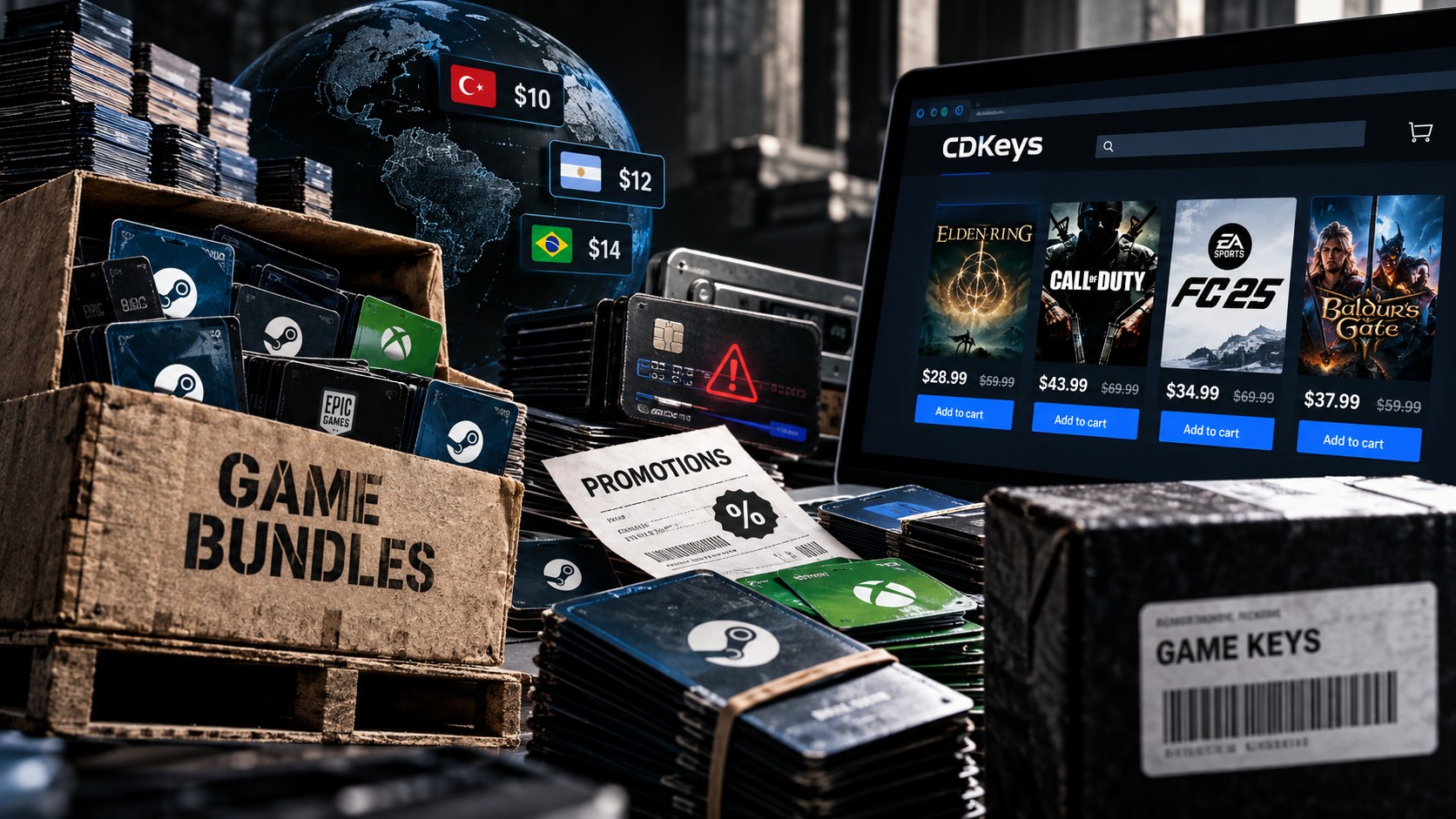
- Cheaper stock can also come from bundles, promotions, regional price differences and secondary-market inventory. A grey-market key is not automatically stolen; the issue is that it sits outside the publisher's approved retail chain.
- Fraud is a separate route that has historically fed some resale markets: a key is bought with stolen payment details, resold quickly, then revoked after the original payment is charged back.
- The useful question is not simply 'Is this key cheap?' but 'Who is selling it, where did the stock come from, is the retailer authorized, and does the key match my region?'
The key itself is not the mysterious part
A Steam key is just a one-use code that grants a product licence when it is activated. The important part is how that code moved from the publisher to the person selling it to you.
That distinction explains why two websites can offer what looks like the same game at wildly different prices.
Steamworks documentation says Steam keys are a free service Valve provides to developers so they can sell games through other stores and at retail, as well as distribute limited keys for testing, press and other approved uses. In other words, buying a Steam game does not require the sale itself to happen on Steam.
A publisher can generate legitimate keys, supply them to another retailer and let that retailer sell them under a separate commercial agreement.
That is the cleanest source of cheap keys.
It is not the only one.
Route one: the reseller is actually an authorized retailer
Some sites commonly described as “key resellers” are closer to ordinary digital retailers.
They have contracts with publishers or distributors, receive legitimate inventory and negotiate their own commercial terms.
Green Man Gaming’s public distribution agreement is unusually useful because it shows the machinery directly. The licensor grants Green Man Gaming the right to sell the game in an agreed territory and supplies the required number of keys.
Fanatical describes a similar relationship. It says it works directly with publishers and developers, and that volume can help produce deeper bundle discounts.
There is nothing inherently strange about this. Physical retailers have always bought inventory below the final shelf price. Digital games can have a wholesale layer too.
The result is simple:
A game can be $60 on a platform store while an authorized retailer legitimately sells a key for $45, $35 or less during a promotion.
The discount does not prove anything shady happened. It may just mean the publisher agreed to a different price through a different sales channel.
Route two: bundles and promotions create very cheap inventory
Keys also enter the market through bundles, giveaways and aggressive promotions.
A publisher may decide that putting a game into a bundle is worth it because the promotion reaches a new audience, revives an older title or generates revenue from a game whose full-price sales have slowed.
That creates an obvious secondary effect: the effective price of each individual game can become tiny.
A buyer may want three games in a ten-game bundle and have no use for the rest. A business may acquire promotional inventory at a very low effective unit cost. Those unused codes can then reappear elsewhere.
This is one reason an older game can show up on a key marketplace at a price that seems impossible when compared only with its current Steam list price.
The Steam list price is not necessarily what the seller paid.
It may not even be close.
There is an important limit here. Not every kind of key is meant to be resold. Valve says beta and developer-comp keys must not be sold, and it places rules around giveaways and external key offers. So “it came from a promotion” does not automatically mean the resale was authorized.
The source matters more than the existence of the code.
Route three: regional pricing creates arbitrage
Games do not cost the same everywhere.
Steam currently supports pricing across dozens of currencies and several regional USD groups. Its pricing tools explicitly let publishers account for exchange rates, local purchasing power and other market conditions.
That can create a large gap between what the same title effectively costs in two countries.
Where the product and activation rules permit it, that gap creates an arbitrage opportunity:
- acquire inventory in a lower-priced market;
- resell it into a higher-priced market;
- charge less than the buyer’s local store price;
- keep the difference.
This is one of the classic grey-market routes.
It is also why region restrictions matter. Publishers do not necessarily want a price designed for one market becoming the global wholesale price.
Ubisoft, for example, tells customers to buy from their own country or region and warns that content bought elsewhere may be region-locked or may not support the expected language. Its approved-distributor page separately warns that an unauthorized retailer may supply an invalid or illegally obtained key.
So regional pricing can explain a cheap key without explaining whether your copy can actually be activated.
Route four: marketplaces let third-party sellers compete
This is where the word “reseller” gets messy.
A store such as Fanatical sells you its own inventory.
A marketplace is different. It provides the venue while outside sellers list the products.
That means the price can be pushed down by competition between sellers who acquired stock through different routes: wholesale agreements, distributors, old promotions, regional inventory or other secondary-market sources.
G2A currently describes itself in these terms. Its 2026 buyer guide says the marketplace’s sellers are registered businesses that go through verification, and says wholesalers and retailers often buy keys in bulk before listing them.
That is G2A’s description of its own present-day controls, not independent proof of the origin of every listing.
And that distinction is the point.
On a marketplace, the platform name does not tell you the full supply chain of a specific key. You are also relying on the seller, the marketplace’s verification system and the accuracy of the listing.
| Supply route | Why the key can be cheap | What the buyer should care about |
|---|---|---|
| Authorized retailer | Negotiated wholesale or promotional pricing | Whether the retailer is approved for that publisher |
| Bundle / promotion | Very low effective cost per game | Whether resale is permitted and whether the key is still valid |
| Regional inventory | Lower local pricing | Activation region and language restrictions |
| Third-party marketplace | Sellers compete using stock from multiple sources | Seller quality, source transparency and refund protection |
| Fraudulent purchase | Fraudster does not bear the real cost | Revocation, chargebacks and supporting criminal activity |
Grey market does not mean “stolen”
This is the distinction most explanations flatten.
A grey-market key is generally a real key being sold outside the publisher’s authorized distribution chain.
A fraudulently obtained key is a different problem.
The two can overlap, but they are not synonyms.
A perfectly functional key might have been bought cheaply in another market or originally included in a bundle. The publisher may dislike that resale because it undermines pricing or distribution strategy, but that is not the same thing as the key being created from nothing or purchased with a stolen card.
This is why the useful dividing line is often authorized versus unauthorized, not real versus fake.
The code itself can be completely real while its route to market is murky.
The fraud route is real — and historically well documented
The worst-case supply chain looks very different.
In 2016, Factorio developer Wube Software described exactly what it had experienced after selling Steam keys through its own site:
- somebody bought a game using stolen payment details;
- the key was quickly resold on a third-party market;
- the real cardholder later disputed the payment;
- the developer received a chargeback;
- the already-resold key could then be revoked.
Wube’s first-party account is useful because it shows why fraud can produce an absurdly cheap key. The person selling it may have paid effectively nothing with their own money.
The discount is not efficiency. It is the proceeds of fraud being converted into cash.
Valve’s current Steam key documentation still gives developers tools to revoke keys that were stolen or purchased fraudulently.
That creates the unpleasant delayed-risk scenario for the final buyer: a key may activate successfully today and disappear later when the original transaction is discovered to have been fraudulent.
Historical fraud problems should not be lazily projected onto every marketplace listing in 2026. Seller verification and anti-fraud controls have changed over time, and major marketplaces now publicly emphasize business verification.
But the mechanism remains important because it explains why “the key worked” is not the same as “the source was legitimate.”
Why the discount can look impossible
A cheap key often seems suspicious because buyers compare it with the wrong reference point.
They see:
Official store: $69.99
Key site: $27.50
and assume the seller somehow acquired a $69.99 product for $69.99 and decided to lose $42.49.
That is usually not the economics.
The seller may have acquired the key:
- at a negotiated wholesale price;
- inside a heavily discounted bundle;
- from a lower-priced region;
- as older inventory bought during a previous promotion;
- from another distributor or reseller;
- or, in a fraudulent case, without bearing the legitimate purchase cost at all.
The current platform price tells you what you would pay through that storefront today.
It does not tell you the reseller’s cost basis.
Who actually gets paid?
This is where the supply route matters most.
With an authorized retailer, the publisher or its distributor is part of the commercial chain. The retailer’s discount is built into that relationship.
With a legitimate secondary-market key, the publisher may have been paid earlier — when the key was originally sold in a bundle, region or wholesale batch — but usually does not receive a fresh full-price sale merely because the key changes hands again.
With a fraudulent key, the original payment can be reversed. That can leave the developer or retailer without the sale and potentially facing chargeback costs, while the downstream reseller has already collected money from the final buyer.
Three keys can activate the same game and represent three completely different economic stories.
How to tell what kind of seller you are looking at
The simplest check is to stop treating every discount key site as the same business.
1. Is it an authorized retailer or a marketplace?
Look at how the site describes itself.
An authorized retailer normally sells inventory it obtained through publisher or distributor relationships. A marketplace hosts offers from third-party sellers.
That difference changes what you need to investigate.
2. Does the publisher recognize the retailer?
Some publishers maintain explicit lists. Ubisoft’s current approved-distributor list, for example, includes stores such as Green Man Gaming, Humble Bundle, Gamesplanet and others.
A retailer being absent from one publisher’s list does not automatically prove wrongdoing across every game, but an explicit publisher relationship is much stronger evidence than a reseller simply calling itself “official.”
3. Is the activation region clear?
A “Steam key” is not enough information.
Check whether it is global, EU-only, North America-only or subject to some other restriction. A very low price is useless if the code cannot be activated on your account.
4. Who handles a bad or revoked key?
Read the refund and replacement policy before buying, not after.
The more opaque the supply chain, the more important it is to know who is responsible if the code is already used, region-blocked or later revoked.
The real answer
Game key resellers get cheap keys because digital games have more than one price and more than one distribution path.
The legitimate end of the market looks ordinary: publishers generate keys, negotiate with retailers, run bundles and price games differently across regions.
The grey end introduces secondary sellers and distribution routes the publisher did not directly approve.
The criminal end uses fraud to create inventory that can be dumped cheaply before the original payment collapses.
All three can produce a code that looks identical in a checkout window.
That is why the price alone tells you almost nothing.
The better question is: what supply chain made this price possible?
Sources & reference material
- Steam KeysSteamworks Documentation · Accessed Oct 09, 2026
Explains that Steam keys are generated by developers, can be used for retail and other digital stores, are provided as a free Steamworks service, and can be revoked when stolen or purchased fraudulently.
- PricingSteamworks Documentation · Accessed Oct 09, 2026
Documents Steam regional pricing across multiple currencies and region groups, including conversion methods that account for purchasing power and local market conditions.
- Online distribution termsGreen Man Gaming · Accessed Oct 09, 2026
Public distribution terms showing an authorized retailer model in which a licensor grants sales rights and supplies game keys to the retailer.
- Why is Fanatical so cheap? Is it legal?Fanatical Customer Services · Accessed Oct 09, 2026
Fanatical says it works directly with publisher and developer partners and receives discounts that can deepen as bundle volume increases.
- Approved digital distributors of Ubisoft gamesUbisoft Help · Accessed Oct 09, 2026
Lists approved Ubisoft retailers and warns that purchases from retailers without a distribution agreement may involve invalid or illegally obtained keys that can be revoked; also warns about regional restrictions.
- Is G2A Safe and Legit? How G2A Works, Why Games Are Cheaper, and How Buyers Stay ProtectedG2A · Accessed Oct 09, 2026
G2A's current description of its marketplace model, including verified business sellers and its claim that wholesalers and retailers often acquire keys in bulk from developers and publishers.
- Friday Facts #171 - So long 2016Factorio / Wube Software · Accessed Oct 09, 2026
First-party developer account documenting a fraud pattern in which keys bought with stolen payment details were resold before the original transactions were charged back.