
The short version
- Cheap does not automatically mean grey market. Publisher-authorized retailers can sell discounted keys that activate on Steam.
- The grey-market question is where the key came from and whether its resale sits within the publisher’s authorized distribution chain. A marketplace’s seller verification is a separate issue.
- A fraudulently obtained key may activate successfully and later be revoked. Steam says key revocation itself does not restrict the buyer’s account.
- Steam cannot refund a key purchased elsewhere. Check the seller’s remedy, activation region, edition and final checkout price before paying.
- Use publisher-listed retailers or verified authorized-store comparisons as your starting point. Avoid listings that supply an account or require you to disguise your location.
A working key can still have a bad history
A game installs. It launches. It appears beside everything else in your Steam library.
That feels like the transaction is settled. But activation only tells you that the platform accepted the code at that moment. It does not show how the seller acquired it.
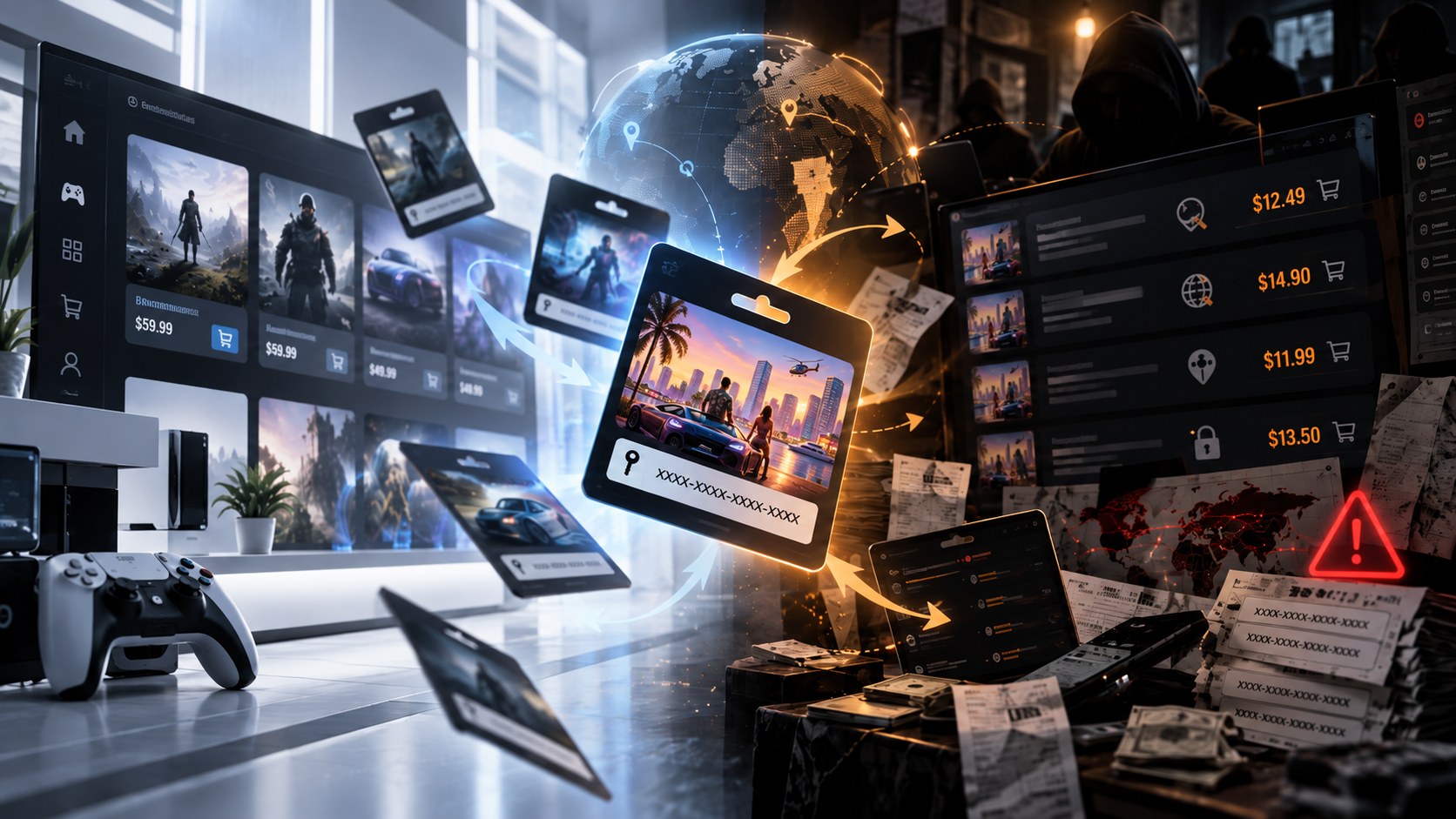
That gap is the central problem with grey-market game keys. The product can be real while its payment history is rotten.
It is also why “all cheap keys are stolen” is a poor explanation. There are legitimate discounts, authorized retailers and ordinary resale margins in the same conversation. The useful question is who supplied the key, and who will deal with you if something goes wrong.
Buying outside Steam is normal
Valve deliberately supports game sales elsewhere. Steamworks documentation describes keys as a way for developers to distribute games through other stores and retail channels.
An authorized shop can sell you a code; you redeem it on Steam; Steam provides the game. The shop and the platform perform different jobs.
Fanatical, for example, says it works with officially licensed publishers. Its games can be discounted without becoming grey-market stock simply because the checkout happens outside Steam.
“Third-party retailer” is therefore too broad to be a warning by itself. The distinction is authorization and sourcing.
| Purchase route | What to establish |
|---|---|
| Platform store or publisher’s own shop | The product, price and applicable refund policy |
| Publisher-authorized key retailer | Its authorization, activation platform and regional eligibility |
| Reseller outside the authorized chain | Where the stock came from and what remedy the seller offers |
| Marketplace listing | Both the platform’s rules and the identity and obligations of the actual seller |
A marketplace can contain different kinds of sellers. A shop selling its own inventory can also have unclear sourcing. The website’s format alone does not settle the question.
Where the discount comes from
A key’s resale price does not have to match today’s Steam Store price. Stock may have been acquired at a lower wholesale price or during an earlier promotion.
G2A’s current explanation of its business points to bulk purchasing, sales and bundles as sources of discounts. It describes itself as a marketplace rather than a distributor and says it accepts business-verified sellers.
Those are the company’s claims about its supply and controls, not an independent audit of every listing. Verifying a business and establishing publisher authorization are different checks.
Regional pricing can create another incentive: stock priced for one market may look especially cheap to a buyer elsewhere. Whether that particular code will activate is a separate question.
There can also be a less dramatic explanation: the seller paid yesterday’s lower price. In its 2019 discussion of Factorio resale, developer Wube floated purchases made before a price increase as one possible source of resale profit.
A low price is a reason to investigate. It is not a receipt showing how the stock was acquired.
The fraud problem is a payment problem
The damaging version begins before the marketplace buyer arrives.
Someone obtains a key using stolen payment details, sells it onward and collects money from another buyer. Later, the original payment is disputed. The business that accepted it can lose the proceeds and incur chargeback costs.
The innocent buyer at the end may have a perfectly functional code until the publisher revokes it.
Paradox Interactive describes this delayed removal in its support warning. It says games have been disabled after codes were bought using stolen or fake cards, sometimes weeks after the purchase.
This is more expensive for the affected business than simply missing a full-price sale. It also makes the buyer’s first successful launch weak evidence of the key’s provenance.
Factorio gives us a documented example
In July 2019, Wube reported fraudulent purchases after Factorio’s Steam launch and published accounts from customers whose resold keys had disappeared from their libraries.
The dispute reached a resolution in May 2020. Wube said G2A had confirmed that 198 of its recorded fraudulently purchased keys were sold on the marketplace. It also confirmed receipt of ten times the associated chargeback fees.
Wube described G2A as open during the discussions and accepted the results, while continuing to recommend official Factorio sources.
That establishes a real incident and a real compensation outcome. It cannot tell us what share of keys on today’s marketplaces are fraudulent. This article has no verified market-wide failure rate, and that old case should not be dressed up as one.
What Steam does when a key goes wrong
Three problems get mixed together in buyer discussions:
- Already used: Steam’s retail-key FAQ says a duplicate-code error means the key has already been registered. It cannot be registered again.
- Wrong region: a valid code can still be ineligible for your territory.
- Revoked later: the publisher can remove access after activation.
Valve’s developer documentation permits revoking stolen or fraudulently purchased keys, while telling developers not to disable keys legitimately sold to customers.
For a buyer, the account distinction matters. Steam’s revoked-key FAQ says that a revoked key does not itself restrict the account. The affected game access is removed.
That should not be stretched into a promise that every buying or activation method is allowed. Account trading and geographic circumvention have their own rules.
Your refund relationship stays with the seller
Steam’s familiar refund offer generally covers Steam Store games within two weeks of purchase and with under two hours played.
It does not follow a key bought elsewhere into your library. Valve explicitly says it cannot refund purchases made outside Steam.
Authorized key retailers also have their own refund terms. Buying from one does not automatically give you the Steam Store policy.
Before paying, establish who handles an invalid key, whether an activated code can be refunded, and whether protection covers later revocation. A promise about delivery today may not cover loss of access next month.
Region locks and account listings change the deal
Steam says retail-key region restrictions vary by publisher. Ask about the exact product before purchase; a broad regional label is less useful than confirmation that your country is eligible.
If a listing requires a VPN or a false residence, the discount comes with another problem. Steam’s Subscriber Agreement prohibits disguising residence to circumvent geographic restrictions or obtain pricing meant for another geography. Valve says it may terminate account access for doing so.
Likewise, a listing that delivers login credentials is selling access to an account rather than a key for your own library. Steam prohibits account transfers except where it expressly permits them.
Do not assume an “account,” “offline activation” or “shared access” offer is interchangeable with an activation code. Read what is actually being delivered. If the bargain depends on someone else’s credentials or instructions for evading the platform’s rules, walk away.
How to find a cheap key without buying blind
Start with the game publisher’s own store or listed retail partners. Then compare authorized-shop offers for the exact edition and your country.
IsThereAnyDeal says it verifies authorized sourcing, asking shops for evidence such as contracts or purchase orders. It excludes marketplaces and grey-market shops. That makes it a useful starting point for comparing discounts within the authorized channel.
Absence from its listings is not proof that a shop is unauthorized. Its coverage explanation also mentions technical limitations and shops it may not know about. For an unfamiliar retailer, check the publisher’s own information.
Before checkout, confirm:
- Product: base game, DLC, upgrade or complete edition; correct activation platform.
- Territory: explicit eligibility for your country, without changing your location.
- Seller: who takes the payment and who handles a failed or revoked key.
- Remedy: the written refund or replacement terms and any claim deadline.
- Total: the final payable amount after applicable fees, taxes and currency conversion.
Keep the receipt and a copy of the listing. If a code fails, preserve the activation error and contact the seller through its order-support process. Steam’s retail-key guidance directs buyers back to the retailer for invalid or duplicate codes; its revocation guidance does the same for refund requests.
Seller ratings can help you assess previous customer experiences. They cannot reveal an individual key’s payment history.
The bargain should survive a closer look
Our recommendation is to compare authorized discounts first. They give you a clearer supply chain without requiring you to pay the platform’s current full price.
For an unauthorized resale, weigh the saving against the uncertainty you are accepting. There is no reliable percentage in this reporting that can turn that judgment into a universal “safe” verdict.
A deal worth taking should remain attractive after you have checked the edition, region, seller, refund terms and checkout total. If it only looks good before those details are visible, keep looking.
How we reported this
We checked platform documentation, publisher accounts and retailer sourcing statements on 9 October 2026. The Factorio incident is historical; marketplace descriptions are attributed to their operators. We did not purchase mystery keys, audit seller inventories or test refund claims. Our buying recommendation is an editorial judgment based on the documented differences between distribution routes.
For a different part of Steam’s economy, see how its Community Market connects game inventories, item sales and Wallet funds.
Sources & reference material
- Steam KeysValve / Steamworks · Accessed Oct 09, 2026
Steam keys support retail and digital distribution outside Steam; developers can revoke stolen or fraudulently purchased keys but should not disable legitimately sold keys.
- Officially Licensed PublishersFanatical · Accessed Oct 09, 2026
Fanatical states that it works with officially licensed publishers, illustrating authorized key retail outside the platform store.
- How we operateG2A · Accessed Oct 09, 2026
G2A describes itself as a marketplace rather than a key distributor, says sellers are business-verified, and attributes discounts to wholesale purchasing and promotions.
- Friday Facts #303 — Under 100 bugs (but still not stable)Wube Software · Accessed Oct 09, 2026
Wube describes fraudulent purchases, chargeback costs and buyers reporting revoked Factorio keys; its discussion also identifies prior lower pricing as a possible source of resale margins.
- Friday Facts #348 — The final GUI update: G2A resolutionWube Software · Accessed Oct 09, 2026
Wube reports that G2A confirmed 198 fraudulently purchased keys were sold on its platform and paid ten times the associated chargeback fees; Wube remained opposed to unofficial Factorio sellers.
- Buying keys from third-party sellers warningParadox Interactive · Accessed Oct 09, 2026
Paradox reports requesting removal of Steam access for codes bought using stolen or fake cards, with delays between purchase and revocation.
- Revoked CD KeysSteam Support · Accessed Oct 09, 2026
Steam explains publisher key revocation, states that revocation itself does not restrict the buyer’s account, and directs third-party buyers to their seller for refunds.
- Retail CD KeysSteam Support · Accessed Oct 09, 2026
A duplicate product-code error means the key is already registered to an account; customers should contact the retailer for assistance.
- Steam RefundsValve · Accessed Oct 09, 2026
The standard Steam Store game refund window is within two weeks and under two hours played; Valve cannot refund purchases made outside Steam.
- Region Restrictions on SteamSteam Support · Accessed Oct 09, 2026
Retail key restrictions vary by publisher; buyers should verify their region and contact the seller for refunds when a key cannot activate in their territory.
- Steam Subscriber AgreementValve · Accessed Oct 09, 2026
Steam prohibits unauthorized account transfers and disguising residence to evade geographic restrictions or obtain region-specific pricing.
- Information for shop representativesIsThereAnyDeal · Accessed Oct 09, 2026
The service requires evidence of authorized sourcing and excludes marketplaces and grey-market shops.
- ShopsIsThereAnyDeal · Accessed Oct 09, 2026
Explains its store-verification approach and why omission can reflect technical coverage limitations rather than unauthorized status.