
The short version
- Account marketplaces turn progress, rare cosmetics, ranks and other account-bound advantages into resale listings.
- The marketplace can reduce payment and delivery risk with escrow, seller history, inspection and disputes, but it cannot make an unauthorized account transfer valid under a publisher’s rules.
- The buyer usually receives control of credentials rather than publisher-recognized ownership, which is why account recovery by the original creator remains a structural risk.
- Many major publishers, including Valve, Riot, Epic and Jagex, explicitly prohibit selling or transferring accounts.
The product is not really the login
A game-account listing can look like an ordinary resale listing: price, screenshots, description, seller rating, buy button.
But the thing changing hands is unusual.
The buyer is not normally purchasing a game account from the company that operates the game. They are paying another player for control of an existing account — and for whatever has accumulated inside it: levels, rank, characters, cosmetics, achievements, currency, old event rewards or a library of purchases.
That difference explains almost everything about the account-selling market.
A marketplace can organize the payment and the handover. It can hold money, record messages, verify sellers and mediate disputes. What it usually cannot do is force the publisher to recognize the buyer as the account’s legitimate new owner.
So every account sale has two layers:
- the marketplace transaction between buyer and seller;
- the publisher relationship that controls whether the account itself remains usable.
Those layers can point in different directions.
How the market turns an account into a listing
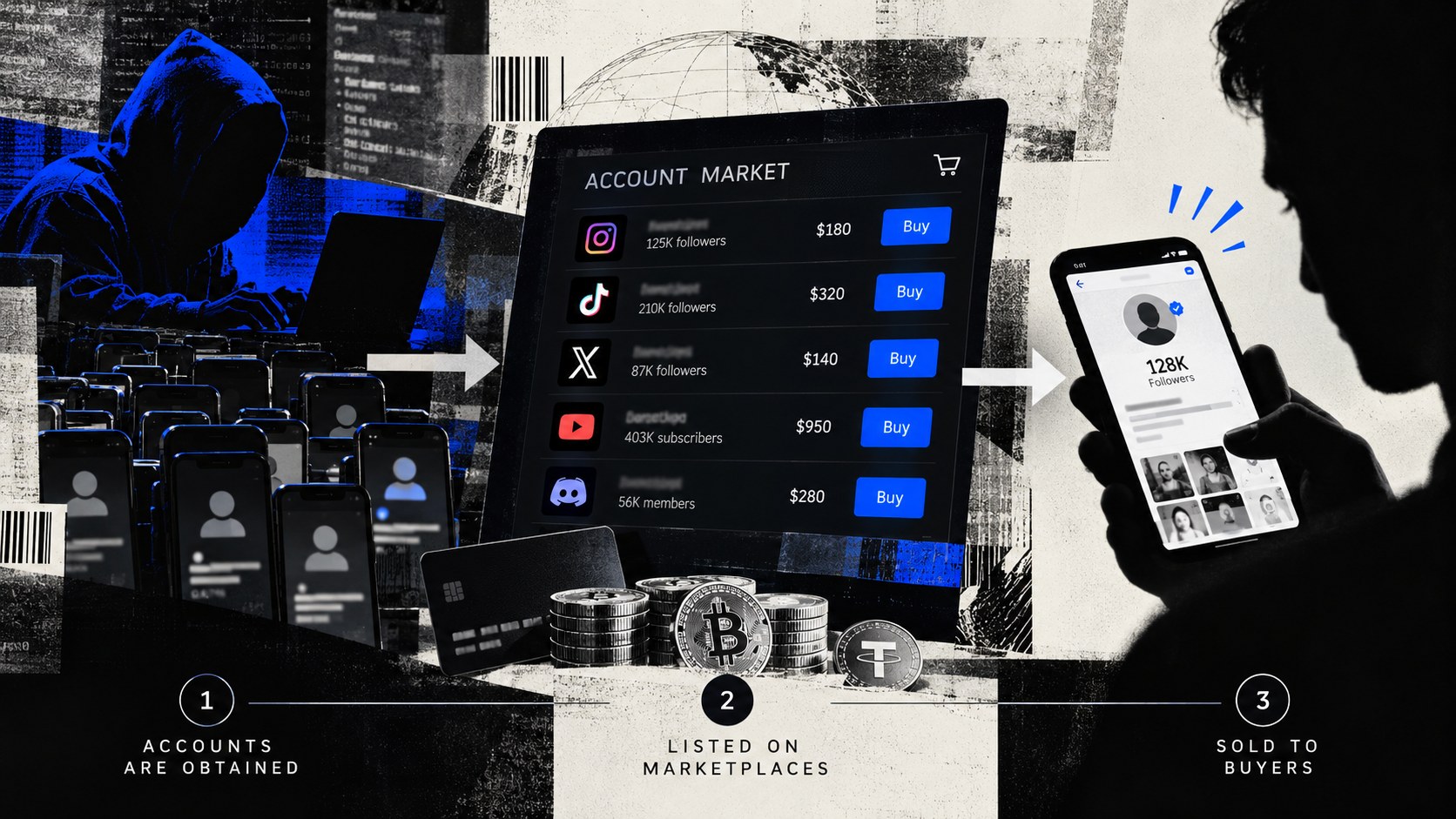
Structured account marketplaces make the trade look much more conventional than a deal in a Discord DM.
On PlayerAuctions, for example, the current flow is broadly: a seller posts an offer, a buyer pays the marketplace, payment is verified, the seller delivers the account details, the buyer confirms delivery and the marketplace releases the seller’s money.
That basic model appears across many account markets because it solves the first obvious problem: neither stranger wants to go first.
The seller does not want to surrender a valuable account before being paid. The buyer does not want to send money and hope credentials arrive later. A marketplace sits between them and turns that trust problem into a managed transaction.
The listing itself tries to make an account legible as a product. PlayerAuctions’ account-selling guidelines tell sellers to disclose details such as items, rank, season, renameability, console linkability, creation region and ban or suspension history.
That gives the market a rough specification sheet.
| Listing signal | What the buyer is really pricing |
|---|---|
| Level / progression | Time and grind already completed |
| Rank | Competitive position or access |
| Rare cosmetics | Scarcity and collectible value |
| Characters / items | Cost and difficulty of rebuilding the inventory |
| Region / platform links | Whether the account fits the buyer’s setup |
| Account age / old rewards | Access to content no longer easily obtainable |
| Ban history / recovery status | Risk that the account disappears later |
Price is therefore not the same thing as the amount originally spent on the account.
An account with $500 of ordinary purchases may attract less demand than one with a single discontinued cosmetic, an old badge or years of progression that cannot simply be rebought. The market is pricing a bundle of time, scarcity, access, status and risk.
Marketplaces sell trust infrastructure
The most important product an account marketplace sells may not be the account at all.
It is the trust layer around the deal.
A mature marketplace can add seller history, identity checks, payment verification, transaction records, credential-delivery systems, dispute handling and delayed payouts. Some also offer a protection period after delivery.
PlayerAuctions, for example, maintains after-sale protection specifically for cases where a purchased account is later reclaimed or suspended because of actions by a previous owner. Some seller payouts can remain withheld during that protection window.
That is revealing.
If the transaction were equivalent to buying a used controller, the marketplace would mostly need to answer one question: did the product arrive as described?
Account markets need to answer a second question weeks later: does the buyer still control it?
Escrow can reduce the risk of paying a stranger who never delivers. A dispute system can deal with a listing that was obviously misrepresented. Seller reputation can make serial abuse more expensive.
None of those mechanisms can erase the account’s history with the game publisher.
Handover is not the same as ownership
A buyer may receive the username, password, email access and whatever other credentials are required to log in. That can create practical control.
It does not necessarily create the strongest recovery claim.
The original creator may still possess older receipts, the first email address, creation details or other evidence that a publisher’s support team recognizes. A marketplace may consider the sale complete while the game operator still sees the account as belonging to the person who originally created it — or may not recognize account transfers at all.
That asymmetry is why account reclamation is such a central risk in the market.
Jagex warns players directly that a seller may take a sold account back after the buyer has already invested more time and resources into it. PlayerAuctions’ protection system likewise has a dedicated dispute path for account reclamation.
The buyer can therefore receive everything promised at checkout and still lose access later.
This is the structural weakness that ordinary marketplace language can hide. A successful credential transfer proves that the buyer can log in now. It does not prove that the publisher has transferred any underlying rights.
It is the same broader problem we see with screenshots and context: evidence of one narrow fact can be mistaken for evidence of a much larger claim.
The publisher sits above the entire secondary market
The largest account markets exist beside, rather than inside, the rules of many major games.
The exact policy depends on the company, but several of the biggest publishers are explicit:
| Platform / publisher | Current position on account sales |
|---|---|
| Steam / Valve | Steam Support says accounts cannot be bought or sold and says an account identified as sold can be permanently locked. |
| Riot Games | Riot’s Terms of Service prohibit selling or transferring an account or login credentials and say users do not hold an ownership interest in the account itself. |
| Epic Games | Epic’s Terms say an account cannot be sold, given away or traded and describe the license as personal and non-transferable. |
| Jagex | RuneScape’s rules prohibit sharing, transferring and selling accounts. |
That means a third-party marketplace can make the transaction orderly without making the transfer publisher-approved.
This is an important distinction. Breaking a game’s terms of service is not automatically the same thing as committing a crime, and the rules vary by service and jurisdiction. But the contractual risk is real: a publisher may suspend or terminate an account even if the buyer and seller both considered the deal legitimate.
Steam makes the consequence unusually clear. Its support page says the buyer can lose the account, along with rank, playtime, purchases and inventory value added after the sale.
From the buyer’s perspective, that makes the asset unusually fragile. Its usefulness depends on a company that was not a party to the resale and may actively reject it.
Why the market exists anyway
If the transfer is this awkward, why is there a market at all?
Because modern game accounts accumulate value faster than most publishers make that value portable.
A long-running account can become a container for years of effort and digital scarcity. It may hold discontinued skins, seasonal rewards, ranked progress, expensive characters or an old game library. To the player leaving the game, that can feel like an asset with obvious resale value. To a new player, buying it can look like a shortcut past hundreds of hours of rebuilding.
The publisher may see the same bundle very differently: as a personal, revocable account license that was never designed to move between people.
That gap creates the secondary market.
The contrast with official item trading is useful. Steam permits certain virtual items to move through authorized marketplace systems under its Subscriber Agreement. That market can transfer eligible items while the user’s Steam account stays with the same person.
A whole-account sale does the opposite. Instead of moving the item, it tries to move the identity container around the item.
That is why account markets appear most strongly wherever desirable value is trapped inside a non-transferable profile.
The main risks come from different layers
It helps to separate the risks instead of treating account trading as one generic scam problem.
| Risk | What causes it | What a marketplace can realistically do |
|---|---|---|
| No delivery | Seller takes payment but never hands over access | Escrow, payment holds and disputes can reduce this substantially |
| Misrepresented account | Rank, inventory or history differs from the listing | Listing evidence, inspection and disputes can help |
| Payment reversal | Buyer receives the account and later reverses or disputes payment | Payment verification and payout reserves can reduce seller exposure |
| Seller reclamation | Previous owner uses recovery channels to regain control | Time-limited after-sale protection may compensate the buyer, but cannot prevent every recovery |
| Publisher enforcement | The game operator detects or otherwise acts on a prohibited transfer | A third-party marketplace cannot override the publisher’s rules |
| Stolen or hijacked origin | The seller was never the legitimate account holder | Verification and fraud screening can reduce exposure, but the original owner may still recover the account |
This is why claims such as “protected by escrow” need to be read narrowly.
Escrow is useful. It solves a real problem. But it mainly protects the transaction while the money is moving.
It does not create permanent title to the account. It does not prevent a future publisher ban. It does not rewrite the recovery system. And once a protection period expires, the buyer may be carrying most of the remaining risk alone.
Account markets are markets for access under uncertain transfer rights
The cleanest way to understand account selling is not as ordinary second-hand commerce.
It is a market for access to accumulated digital value when the official platform often does not provide a supported way to transfer that value between people.
Marketplaces make that shadow resale market more organized. They turn accounts into comparable listings, hold payments, build seller reputations and create dispute systems around a transaction that would otherwise happen between strangers.
But the market has a ceiling: the publisher still controls the account system.
That is why a sold game account can be valuable, deliverable and usable while still being a weak form of ownership. The marketplace can transfer credentials. The publisher decides whether those credentials continue to mean anything.
Sources & reference material
- How Selling Works on PlayerAuctionsPlayerAuctions Help Center · Accessed Oct 10, 2026
Documents a current account-market transaction flow in which a seller lists an offer, the buyer pays the marketplace, the account is delivered and the seller is paid after buyer confirmation.
- Account Selling GuidelinesPlayerAuctions Help Center · Accessed Oct 10, 2026
Shows the account attributes marketplaces expect sellers to disclose, including items, rank, region, linkability and ban or suspension history.
- How does after-sale protection work?PlayerAuctions Help Center · Accessed Oct 10, 2026
Documents post-sale disputes for accounts that are reclaimed or suspended because of a previous owner and shows that buyer protection is time-limited.
- Buying or selling a Steam accountSteam Support · Accessed Oct 10, 2026
States that Steam accounts cannot be bought or sold and that accounts identified as sold can be permanently locked.
- Riot Games Terms of ServiceRiot Games · Accessed Oct 10, 2026
States that Riot accounts and login credentials cannot be sold or transferred and that users do not hold an ownership interest in the account or virtual content.
- Epic Games Terms of ServiceEpic Games · Accessed Oct 10, 2026
States that an Epic Games account cannot be sold, given away or traded and describes the associated license as personal, non-transferable and revocable.
- Rules of RuneScapeJagex · Accessed Oct 10, 2026
States that RuneScape accounts must not be shared, transferred or sold and explains the risk that a seller can later recover a sold account.
- Steam Subscriber AgreementValve · Accessed Oct 10, 2026
Provides an example of an authorized platform marketplace for certain virtual items, illustrating the difference between publisher-approved item trading and whole-account resale.