
The short version
- No single comment proves that engagement was purchased. Short praise, emojis, foreign-language replies and fast responses can all occur organically.
- The strongest clues appear in clusters: comments that are interchangeable across posts, arrive in unnatural batches, come from the same recurring accounts or show little evidence of genuine conversation.
- Inspect commenters as a group rather than judging one profile. Repeated posting patterns, thin activity histories and the same accounts appearing across unrelated creators are more useful than one odd username.
- Modern fake engagement can use real people or AI-generated, context-aware text, so grammatical quality and apparent relevance are no longer reliable authenticity tests.
- Treat a manual audit as a risk assessment, not a forensic verdict. Platform data, seller records or direct admission are much stronger evidence of purchase.
The giveaway is usually the pattern, not the comment
A comment that says “Love this 🔥” proves almost nothing.
Real people write short comments. Real fans repeat themselves. A Reel can attract a burst of strangers in minutes. A creator with an international audience can suddenly receive replies in five languages. Even a profile with no posts may belong to a real person who only watches.
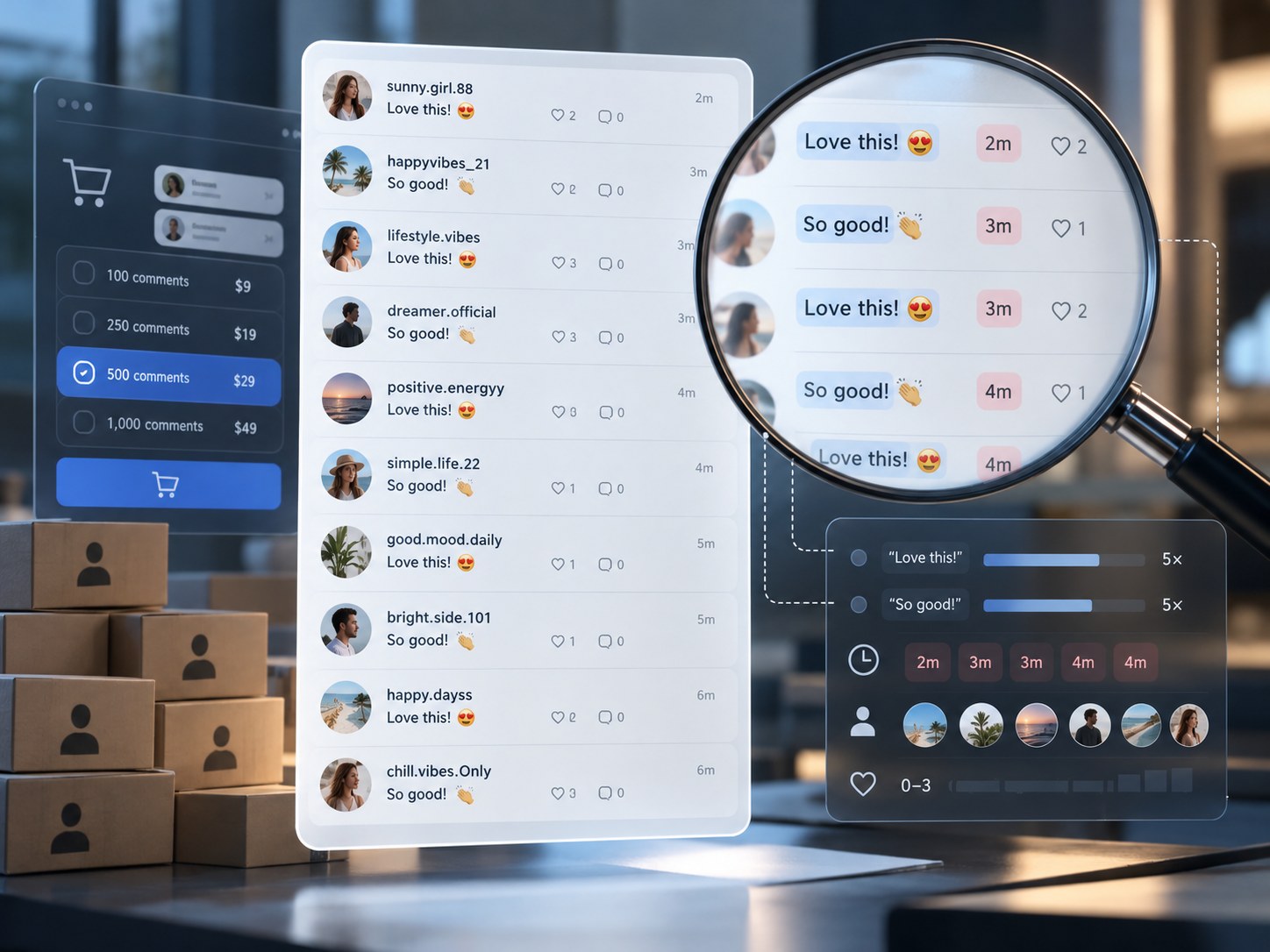
Purchased comments become easier to recognize when you stop asking whether one comment looks fake and start asking whether the comment section behaves like an audience.
That means checking several things at once: what the comments say, when they arrive, who posts them, whether the same accounts recur and whether any actual conversation develops.
The important shift is from spotting weird comments to spotting coordinated engagement.
First, define what “purchased comments” means
The phrase covers several different systems.
At the cheap end, a service may use automated or disposable accounts to post templated praise. Meta has previously taken legal action against services it said distributed fake likes and comments on Instagram through automation.
Other operations use people. In 2020, Meta described coordinated campaigns in which authentic and fake accounts were used to comment under other people’s posts to make particular views look more widely supported or criticized than they really were. In one case, the activity appeared to run in regular weekday work shifts.
There is also a newer version: comments that are generated at scale but are no longer obviously generic. In Meta’s H2 2026 threat reporting, one disrupted network used AI to mass-produce contextually relevant comments for automated accounts designed to boost engagement.
So the old rule — “bad grammar means bot” — is badly outdated.
A purchased comment can be:
- automated;
- written by a low-paid human operator;
- posted by a real account participating in an engagement scheme;
- generated by AI and then posted automatically;
- customized to mention something from the actual post.
That is why the audit has to look beyond the sentence itself.
Test whether the comments are actually about the post
The fastest manual check is simple: read the comments as language, not as a metric.
Ask whether each comment contains information that anchors it to the post.
A response such as “the third setup is easily the best” could only make sense under a post containing multiple setups. “Where did you get the jacket at 0:12?” refers to a specific moment. A disagreement with a claim in the caption is even harder to reuse blindly.
Now compare that with comments such as:
- “Amazing content”
- “So good 🔥”
- “Love this”
- “Keep it up”
- “Nice post 😍”
None of those comments is fake by definition. The problem appears when most of a large comment section is interchangeable.
A useful mental test is to move the comment to a completely different post. If it would work just as well under a gym video, a restaurant photo and a crypto chart, it contains almost no evidence that the commenter actually engaged with the content.
But specificity is no longer enough on its own. AI systems can generate comments that mention objects, captions and themes correctly. Treat relevance as one signal, not a verdict.
Look at the timing
Purchased engagement often has a delivery schedule.
The visible result can be a block of comments landing within a narrow window, followed by very little activity. Another suspicious shape is a delayed batch: an older post suddenly receives dozens of low-context comments at nearly the same time.
Organic attention is usually messier. A post may spike immediately because followers receive notifications, then receive another wave if the platform recommends it, then collect long-tail comments for days. Viral posts can produce enormous bursts that are completely legitimate.
So timing only becomes useful when you compare it with context.
Ask:
- Did the post go viral at the same time?
- Was it shared by a larger account?
- Did it hit a news cycle or trend?
- Did the creator run a giveaway or ask a question?
- Do other posts show the same tight delivery pattern?
A burst with an obvious traffic event is ordinary. A burst that repeats across otherwise unremarkable posts is more interesting.
Audit the commenters as a group
One empty-looking profile is weak evidence. Twenty profiles with the same behavioral pattern are different.
Open a sample of commenters and compare them.
Useful things to notice include:
- little or no original posting history;
- extremely high following counts paired with minimal personal activity;
- feeds that appear recently created or mechanically populated;
- bios, usernames or profile images that follow the same template;
- accounts whose visible activity is dominated by generic praise;
- the same accounts commenting on several of the creator’s posts;
- the same accounts appearing under multiple unrelated creators.
Do not turn any one of these into a hard rule. Plenty of genuine users have private accounts, no posts or ugly usernames.
The question is whether the accounts look like independent people with independent behavior or like a cohort built for engagement.
This distinction matters because automated accounts can be extremely active. A 2019 ICWSM study examining roughly two million Facebook comments found that the bot accounts detected in its dataset represented only a small share of commenting users but produced comments at a sharply disproportionate rate. The lesson is not that every prolific commenter is a bot. It is that behavior across an account can reveal more than the wording of one reply.
Check whether the same crowd follows every post
Real communities absolutely have regulars. Seeing familiar names is healthy.
What becomes suspicious is a nearly fixed cast appearing under post after post regardless of subject.
Imagine an account posts:
- a product launch;
- a family photo;
- a political opinion;
- a travel Reel;
- a meme.
If the same 30 accounts arrive rapidly under all five and leave similarly positive, low-specificity comments, that looks less like topic-driven interest and more like a standing engagement mechanism.
This can happen through purchased services, engagement pods or coordinated groups. From the outside, you may not be able to tell which.
That distinction is important.
“Coordinated” is not automatically the same as “purchased.”
If the evidence only shows the same group boosting one another, say that. Do not upgrade a pattern into a financial claim without evidence of payment.
Real conversation has friction
Purchased engagement is usually optimized to create a number.
A real comment section does more than increment the counter.
People ask follow-up questions. Someone misunderstands the post. A friend tags another friend with context. The creator answers. Two strangers disagree. A joke turns into a thread. Some comments are enthusiastic, some are boring and some are mildly negative.
That irregularity is useful.
A section containing 300 comments but almost no replies, no questions, no disagreement and no specific discussion may be visually busy while remaining socially empty.
This is not a mathematical rule. Celebrity posts can receive thousands of one-way reactions. Some creators rarely reply. Some audiences communicate almost entirely through emojis.
Again, the strength comes from the combination: generic language + coordinated timing + suspicious commenter cohort + no conversational texture is more meaningful than any one of those alone.
Watch for comments that are too consistently positive
Purchased comments are often bought for social proof.
That creates a selection problem: the customer is usually not paying for fifty strangers to say the post was boring.
A suspicious section may therefore have high volume but almost no natural variation. Every reply is praise. Every product question sounds enthusiastic. Nobody asks about shipping, pricing, limitations or something that did not work.
Real audiences are not automatically hostile, but they are usually less perfectly aligned.
This is especially important when comments are being used as evidence that customers love a product, course, investment service or business.
A comment section is an engagement surface. It is not the same thing as independently verified customer feedback.
In the United States, the FTC’s current reviews and testimonials rule guidance separately addresses fake or false reviews and testimonials, paid reviews conditioned on sentiment and fake indicators of social-media influence. The exact legal treatment depends on what the comments are doing and how they are being used commercially.
Do not rely on a magic engagement ratio
There is no universal “real comments per 1,000 likes” number.
Different platforms, niches and post formats behave differently. A meme account, a beauty tutorial, a celebrity post and a small B2B founder account can have wildly different like-to-comment ratios while all being legitimate.
Ratios are most useful within the same account.
Compare similar posts over time:
- Does a normal post receive 20 comments, then a random post receives 400 without a reach spike?
- Do comments jump while likes, shares and visible views stay flat?
- Does every post seem to receive almost exactly the same number of comments?
- Does comment volume change in neat blocks rather than with content performance?
Those mismatches justify a closer look. They do not prove a purchase.
This is the same reason creator analytics need context. A metric becomes more informative when you can compare it with the surrounding system.
Platform rules confirm the behavior exists — but not who bought it
Major platforms explicitly treat artificial engagement as a manipulation problem.
TikTok’s current Integrity and Authenticity guidelines prohibit buying or selling followers or engagement for financial gain and say the platform may remove fake or inflated signals it detects.
YouTube says it does not allow activity that artificially increases views, likes, comments or other metrics, whether through automatic systems or other illegitimate methods.
Those policies are useful because they establish that artificial engagement is not a hypothetical category.
They do not give an outside observer access to the platform’s internal detection data.
If you are auditing someone else’s account, you usually cannot see device fingerprints, IP clusters, payment records, automation infrastructure or enforcement signals. You are working from public evidence.
That means your conclusion should stay proportional to what you can actually observe.
A practical five-minute audit
For a quick manual check, do this:
- Open five to ten recent posts rather than the single most suspicious one.
- Read at least 30 comments and mark which ones specifically reference the post.
- Note whether comments arrive in repeated batches or unusually uniform windows.
- Open a sample of commenter profiles and look for recurring behavioral patterns.
- Check whether the same accounts repeatedly appear across unrelated posts.
- Look for actual threads, questions, disagreement and creator replies.
- Compare comment volume with the account’s own normal range and visible reach.
Then write the conclusion in risk language.
Weak conclusion: “These comments are definitely bought.”
Stronger conclusion: “This account shows several indicators of coordinated or inauthentic commenting: repeated generic replies, the same commenter cluster across posts and batch-like timing. Public data alone does not establish who paid for it.”
That wording may sound less dramatic.
It is also more accurate.
What does not prove purchased comments
Several popular “tells” are too weak to use alone.
| Signal | Why it can look suspicious | Why it is not proof |
|---|---|---|
| Emoji-only replies | Easy to automate or purchase | Real fans use emojis constantly |
| One-word praise | Generic and reusable | Real people also write “nice” |
| Foreign-language comments | May not match the creator’s apparent market | Social audiences are global |
| Empty profiles | Disposable accounts can look this way | Many real users never post |
| Fast comments | Engagement services can deliver in batches | Followers and viral reach can arrive instantly |
| Repeating commenters | Pods and paid systems reuse accounts | Real communities have regulars |
| Perfect grammar | Older bots often failed here | Humans and AI can both write clean copy |
| Specific comments | Better than generic filler | AI can now generate contextual replies |
The strongest evidence is not a checklist item. It is a repeating pattern that becomes hard to explain as independent audience behavior.
The comments are not the proof; the network is
Purchased comments used to be easier to caricature: empty accounts posting “Awesome pic!” beneath everything.
That still exists.
But the more useful model in 2026 is broader. Artificial engagement can involve bots, real workers, authentic accounts, coordinated groups and AI-generated text that correctly references the content.
The sentence can look real.
The account can look real.
The comment can even be written by a real person.
What matters is whether the activity behaves like independent people choosing to participate — or like a system designed to manufacture the appearance of participation.
When you cannot establish the difference, say that too.
A comment count is evidence that comments appeared. It is not automatically evidence of demand, trust, customers or a real community.
Sources & reference material
- Community Guidelines — Integrity and AuthenticityTikTok · Accessed Oct 10, 2026
TikTok prohibits buying or selling followers or engagement for financial gain and says it removes inauthentic engagement signals it detects.
- Fake engagement policyYouTube Help · Accessed Oct 10, 2026
YouTube prohibits artificially increasing views, likes, comments or other metrics and defines legitimate engagement around authentic user intent.
- Taking Legal Action Against Those Who Abuse Our ServicesMeta · Accessed Oct 10, 2026
Meta described legal action against an Instagram automation service designed to distribute fake likes and comments.
- Removing Coordinated Inauthentic BehaviorMeta · Accessed Oct 10, 2026
Meta documented coordinated commenting campaigns using both fake and authentic accounts to create the perception of broad support or criticism.
- Israel-Based Influence Operation Targeting France, the United Kingdom, Australia, Iran, Togo, Gabon, and AngolaMeta Threat Research · Accessed Oct 10, 2026
Meta's H2 2026 threat reporting described automated fake accounts using AI to mass-produce contextually relevant comments to artificially boost engagement.
- The Consumer Reviews and Testimonials Rule: Questions and AnswersFederal Trade Commission · Accessed Oct 10, 2026
FTC guidance explains its rule on fake or false reviews, testimonials and fake indicators of social-media influence, including circumstances involving purchased or brokered activity.
- Detecting Social Bots on Facebook in an Information Veracity ContextProceedings of the International AAAI Conference on Web and Social Media · Accessed Oct 10, 2026
Research using about two million Facebook comments found a small detected bot population could produce a disproportionately large share of comments, illustrating why account-level behavior matters.