
The short version
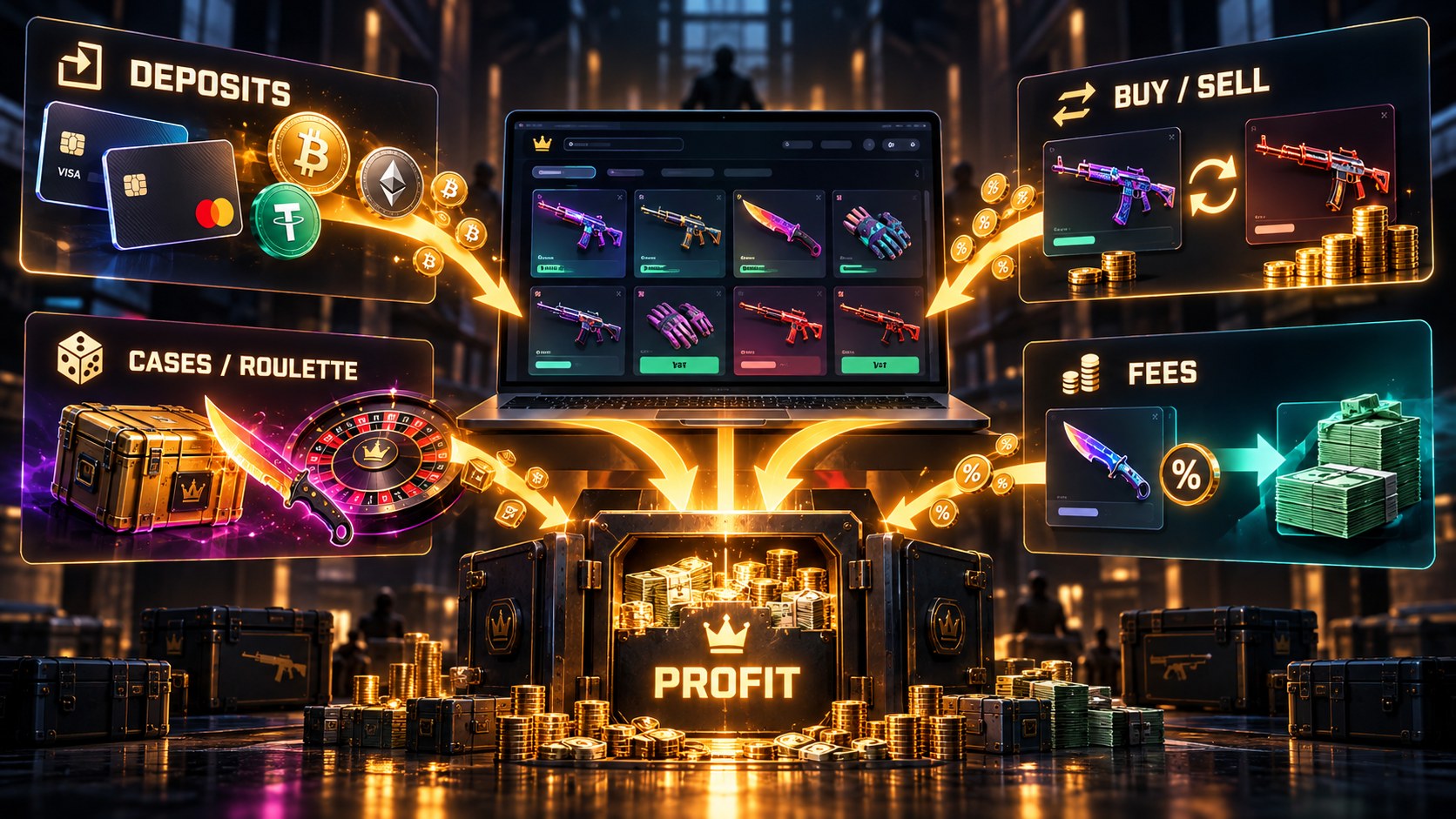
- The basic business model is a transaction cut: third-party skin marketplaces charge sellers, traders or both for moving an item through the platform.
- Cash-out is the key economic wedge. Steam Community Market proceeds stay inside Steam Wallet, while third-party sites compete by turning skins into withdrawable bank or crypto value.
- Marketplace models earn explicit commissions; current examples include 2% on CSFloat, 8% on standard Skinport public sales and 2% to 10% on DMarket CS2 sales depending on liquidity.
- Instant-sell and trade-bot services can earn through a fee or spread embedded in the quote. Tradeit currently discloses a 5% to 20% instant-sell platform fee depending on the item.
- A marketplace fee is gross revenue, not pure profit. Payment processing, fraud, chargebacks, KYC, support, marketing, infrastructure and regulatory costs sit underneath it.
The product is not the skin. It is liquidity.
A grey-market skin site does not need to design an AK-47 finish, mint a knife or convince Valve to create another cosmetic.
The item already exists.
What the site sells is a route between three things that Valve keeps partly separate: a Steam inventory, another buyer, and money that can leave the ecosystem.
That last part matters most. Steam’s own Community Market FAQ says proceeds from Community Market transactions stay in Steam Wallet and cannot be withdrawn to a bank or third-party account. Valve’s Subscriber Agreement goes further: Steam Wallet funds have no cash value outside Steam and are not exchangeable for cash.
Third-party markets step into that gap.
They let a seller turn a Counter-Strike 2 item into bank money, crypto or another form of off-platform value. In return, the operator takes a cut, charges for the cash-out, builds a margin into an instant quote, or combines several of those models.
That is the business.
In this article, grey market means an independent resale or cash-out channel that sits outside Valve’s first-party marketplace. It is a description of the channel, not a blanket claim that every third-party site is illegal, unsafe or deceptive.
The first model is the obvious one: take a percentage of every sale
The cleanest skin-market business looks a lot like any other marketplace.
A seller lists an item. A buyer pays. The platform handles discovery, transaction flow and some level of settlement or custody. The platform keeps a percentage.
The percentages vary dramatically.
Skinport says its standard public selling fee is 8%, with 6% for qualifying high-value public listings and 2% for private sales.
CSFloat currently advertises a 2% sale fee.
DMarket’s current fee table says CS2 sale fees are usually 2% to 10% depending on item liquidity, while its separate trade operation carries a 2.5% fee.
Those numbers are not side details. They are the revenue engine.
| Marketplace model | Published user charge | What creates platform revenue |
|---|---|---|
| CSFloat marketplace | 2% sale fee | Cut of completed sale value |
| Skinport public marketplace | 8% standard seller fee | Cut of completed sale value |
| Skinport high-tier public sale | 6% | Smaller cut on qualifying expensive items |
| Skinport private sale | 2% | Lower-fee transaction without public marketplace discovery |
| DMarket CS2 sale | Usually 2%–10% | Fee changes with item liquidity |
| DMarket trade | 2.5% | Cut on an item-for-item exchange operation |
Fees change, so the point is not that one percentage is permanent. The point is structural: every time an item changes hands through the platform, the platform has an opportunity to monetize the movement.
This is the same basic marketplace logic we describe in how Steam’s Community Market works. The difference is that third-party sites are competing over a more valuable promise: cash liquidity.
Steam created the cash-out gap without offering cash-out
Steam already has a massive built-in item market.
It also has a deliberate boundary around the money.
For Counter-Strike items, Steam’s FAQ lists a 5% Steam Transaction Fee and a separate 10% Counter-Strike fee. The buyer pays those charges as part of the Community Market transaction. More importantly for the grey market, the seller receives Steam Wallet funds rather than withdrawable cash.
A Steam price and a cash-market price are therefore not automatically the same thing.
If a skin sells for the equivalent of $500 inside Steam, that does not mean the owner possesses $500 that can be sent to a bank account. It means they hold Steam Wallet value subject to Steam’s rules.
Third-party markets monetize the conversion from item value to cash value.
That distinction explains why comparing a Steam listing with a cash-market listing purely by sticker price can be misleading. The settlement asset is different.
One market pays in closed-loop platform credit.
The other is trying to pay in money you can actually take elsewhere.
The second layer is the withdrawal fee
A low seller fee does not necessarily mean the platform only earns that one percentage.
CSFloat is a clean example. Its site publishes a 2% sale fee, then says bank or crypto withdrawals carry a dynamic 0.5% to 2.5% fee depending on total sales volume.
A seller can therefore pay once when the skin sells and again when the proceeds leave the platform.
On a hypothetical $500 sale:
- 2% sale fee = $10;
- seller balance after the sale fee = $490;
- a 0.5% withdrawal charge on that balance = $2.45;
- a 2.5% withdrawal charge = $12.25.
The published charges would total between $12.45 and $22.25 before considering taxes, exchange-rate effects or any external payment-provider costs.
That does not mean every dollar of the withdrawal fee becomes profit. Part of it may be consumed by the cost of actually moving money.
It does mean the headline seller fee is not always the complete business model.
The same logic appears across online payments generally: gross transaction value, platform fee, processor cost and net payout are different numbers. We break that distinction out in where the money goes after an online sale.
Instant-sell sites make money differently: the fee can disappear into the quote
Not every skin site waits for another player to buy your item.
Some offer instant sell.
That changes the economics.
Instead of acting only as a marketplace connecting two users, the service can quote a price immediately, take the item and then carry the risk of reselling or reusing that inventory later.
The margin can be explicit, but it can also be embedded in the price.
Tradeit’s current seller documentation says its Instant Sell platform fee ranges from 5% to 20% depending on the item and is reflected in the price shown to the seller rather than charged separately afterward.
That is economically different from an 8% marketplace commission.
With a marketplace, the seller chooses a listing price and waits for a buyer.
With instant sell, the site is effectively saying: we will give you certainty and speed now, but at a worse conversion rate.
A hypothetical 5% to 20% fee against a $500 internal valuation corresponds to $25 to $100 of value. But that number should not be compared mechanically with a marketplace fee, because the site is also taking price risk, inventory risk and resale timing risk.
CS.MONEY’s terms show another version of the model. Its Trade Mode prices are set by its own system, transaction commissions can vary by specific exchange, sale or purchase, and commissions for items held on its bots are described as ranging from 0% to 13% depending on how long the item has been held.
In both cases, the platform is doing more than matching two strangers. It is pricing inventory.
That creates room for a spread: the difference between what the platform gives up to acquire an item and what it later receives when that item is sold, exchanged or repriced.
Why would anyone accept a 10% or 20% haircut?
Because the user is not buying the lowest possible fee.
They are buying some combination of:
- immediate liquidity;
- a known cash quote;
- less waiting;
- automated inventory handling;
- payment and payout infrastructure;
- lower counterparty friction;
- access to a larger pool of buyers;
- convenience.
The trade-off is familiar outside gaming.
A pawn shop pays less than the theoretical private-sale value of an object because it is buying immediately and taking on the burden of resale. A card processor takes a percentage because it moves money and absorbs infrastructure and fraud costs. A marketplace charges because it creates discovery and trust between two sides.
Skin sites combine pieces of all three.
The fee is revenue. It is not the same thing as profit.
An 8% seller fee sounds enormous if the only mental model is “website takes item, website takes money.”
The operator’s cost base is broader.
Skinport explained this unusually directly when it changed its fee structure in 2021. In its published breakdown, the company said seller fees had to cover:
- payment-provider fees;
- currency conversion;
- chargebacks and chargeback fees;
- Know Your Customer verification;
- employees;
- marketing;
- server hosting;
- taxes;
- profit after those costs.
That list is useful because it punctures one of the easiest misconceptions about these businesses.
If a marketplace processes $1 million of skin sales at an 8% commission, $80,000 is gross fee revenue, not automatically $80,000 of profit.
The business still has to pay the stack underneath the transaction.
And the stack can be unusually messy. A conventional ecommerce store controls its inventory and its checkout. A skin marketplace has to coordinate game-item transfers, account security, payment risk, cash withdrawals, identity checks, fraud prevention and platform rules it does not control.
The site is a layer sitting on top of Steam.
Steam can change the ground underneath it.
Liquidity itself can be priced
DMarket’s variable CS2 fee illustrates another subtle model: charge more when an item is harder to move.
Its current help page says more liquid CS2 skins can be subject to a 2% seller commission while less liquid items can reach 10%.
That makes economic sense.
A common, actively traded skin is easier for a marketplace to price and easier for buyers to absorb.
A strange pattern, unpopular finish or thinly traded item may take longer to sell, generate fewer comparable transactions and create more uncertainty around the right price.
The marketplace can respond in two ways:
- let the seller absorb the illiquidity through a lower achievable sale price;
- explicitly charge a higher fee for the transaction.
Some sites do both indirectly.
This is why “lowest fee” does not answer the full question of which market is cheapest. The better comparison is cash you actually receive after realistic sale price, platform fees and withdrawal costs.
Affiliate programs reveal where the money is coming from
Affiliate marketing looks like a separate topic, but it is useful evidence of the underlying economics.
DMarket says eligible affiliates receive 20% of DMarket’s income from commissioned transactions generated by referred users, and it defines those commissioned transactions as sale and trade operations that include DMarket fees.
That wording is unusually transparent.
The affiliate is not receiving 20% of the skin’s sale price.
The affiliate is receiving a share of DMarket’s fee income.
In other words:
user trades → platform collects fee revenue → platform shares some of that revenue with the person who acquired the user.
The creator code, YouTube sponsorship or affiliate banner is not magic marketing money. It is customer-acquisition spending funded by transaction economics.
That same loop is why skin marketplaces are so visible around streamers, esports creators and trading content. A user who trades repeatedly can generate fee revenue repeatedly.
A $500 skin can produce very different economics
Using only currently published headline charges, a hypothetical $500 transaction can look like this:
| Route | Published fee mechanism | Approximate user-side charge before other costs |
|---|---|---|
| CSFloat sale | 2% marketplace fee | $10 |
| Skinport standard public sale | 8% marketplace fee | $40 |
| DMarket CS2 sale | 2%–10% depending on liquidity | $10–$50 |
| Tradeit Instant Sell | 5%–20% platform fee embedded in quote | $25–$100 equivalent against a $500 reference value |
These are not four interchangeable services.
CSFloat is describing a marketplace sale.
Skinport is describing a public marketplace sale.
DMarket changes the commission according to the item.
Tradeit’s fee is part of an immediate purchase quote.
The table is useful precisely because the advertised percentages look comparable when the economic job is not.
If a site takes custody, quotes an immediate price and later has to resell the item, a larger margin may be paying for a very different service than a 2% peer-to-peer listing fee.
The hidden dependency is Valve
None of these businesses controls the asset layer.
Valve does.
Third-party marketplaces rely on Steam accounts, Steam inventories and Steam item-transfer rules to make the external market function.
That dependency is visible in current settlement flows. Tradeit’s August 2026 documentation says a sold item’s revenue can appear immediately, but the platform waits through Steam’s seven-day Trade Protection period before the funds become withdrawable.
A rule implemented by the game platform therefore changes when the skin marketplace can safely release cash.
That is a structural risk in the business model.
A normal marketplace can redesign its own checkout.
A Counter-Strike skin market has to redesign around whatever Valve decides an item transfer means tomorrow.
The more volume a third-party operator processes, the more important fraud controls, reserves, identity checks and settlement timing become.
“No buyer fee” does not mean the transaction is free
Another easy mistake is to look at a marketplace that charges the seller and conclude that buyers are costless.
Someone still pays for card processing, chargebacks, currency conversion and payout infrastructure.
Skinport’s 2021 fee explanation is explicit about this. The company removed its buyer fee and said those costs would instead be covered through the seller fee.
The economic burden moved.
It did not disappear.
That is common in two-sided marketplaces. An operator can decide which side sees the fee line, while the final price and seller proceeds adjust around it.
A marketplace can therefore advertise:
- no buyer fee;
- a seller fee;
- free or low-cost payout;
- no subscription;
and still have a perfectly coherent revenue model.
The commission is doing several jobs at once.
So how do grey-market skin sites make money?
Mostly by charging for conversion and convenience.
The item starts as a game cosmetic.
The user wants something else: another item, an instant quote, a liquid marketplace, bank money, crypto, speed, price discovery or a smoother trade.
The third-party site sits in the middle and monetizes that change of state.
A pure marketplace takes a commission.
A cash-out platform can add a withdrawal fee.
An instant-buy or trade-bot service can build a spread or platform fee into the quote.
A larger operator can use part of those fees to pay affiliates, processors, fraud losses, KYC vendors, staff, infrastructure and taxes — and keep whatever is left as profit.
The important distinction is that the skin is not where the business model lives.
The business model lives in the friction between owning a virtual item and turning that item into something else.
Sources & reference material
- Community Market FAQSteam Support · Accessed Oct 09, 2026
Documents Steam Community Market fees and confirms that sale proceeds remain Steam Wallet funds that cannot be withdrawn to a bank or third-party account.
- Steam Subscriber AgreementValve · Accessed Oct 09, 2026
States that Steam Wallet funds are non-transferable, have no value outside Steam and are not exchangeable for cash.
- Lower Fees for Everybody!Skinport · Accessed Oct 09, 2026
Documents Skinport's current 8% standard public selling fee, 6% high-tier public fee and 2% private-sale fee.
- Changes to the fee structure on Skinport in March 2021Skinport · Accessed Oct 09, 2026
Explains that Skinport's seller fee is used to cover payment processing, currency conversion, chargebacks, KYC, employees, marketing, hosting, taxes and profit.
- CSFloat — Buy & Sell CS2 SkinsCSFloat · Accessed Oct 09, 2026
Publishes a 2% sale fee and dynamic bank or crypto withdrawal fees ranging from 0.5% to 2.5% based on sales volume.
- DMarket FeesDMarket · Accessed Oct 09, 2026
Documents CS2 seller fees that usually range from 2% to 10% depending on item liquidity and a separate 2.5% trade fee.
- How to share the Affiliate link and get revenue?DMarket · Accessed Oct 09, 2026
States that affiliates can receive 20% of DMarket's income from fee-bearing sale and trade transactions generated by eligible referrals.
- Selling items on Tradeit and when you get paidTradeit · Accessed Oct 09, 2026
Documents Tradeit's instant-sell model and a 5% to 20% platform fee that is reflected directly in the quote shown to the seller.
- CS.MONEY — Terms of UseCS.MONEY · Accessed Oct 09, 2026
Documents transaction-specific commissions in Trade Mode and a commission range of 0% to 13% for items held on CS.MONEY bots depending on holding time.