
The short version
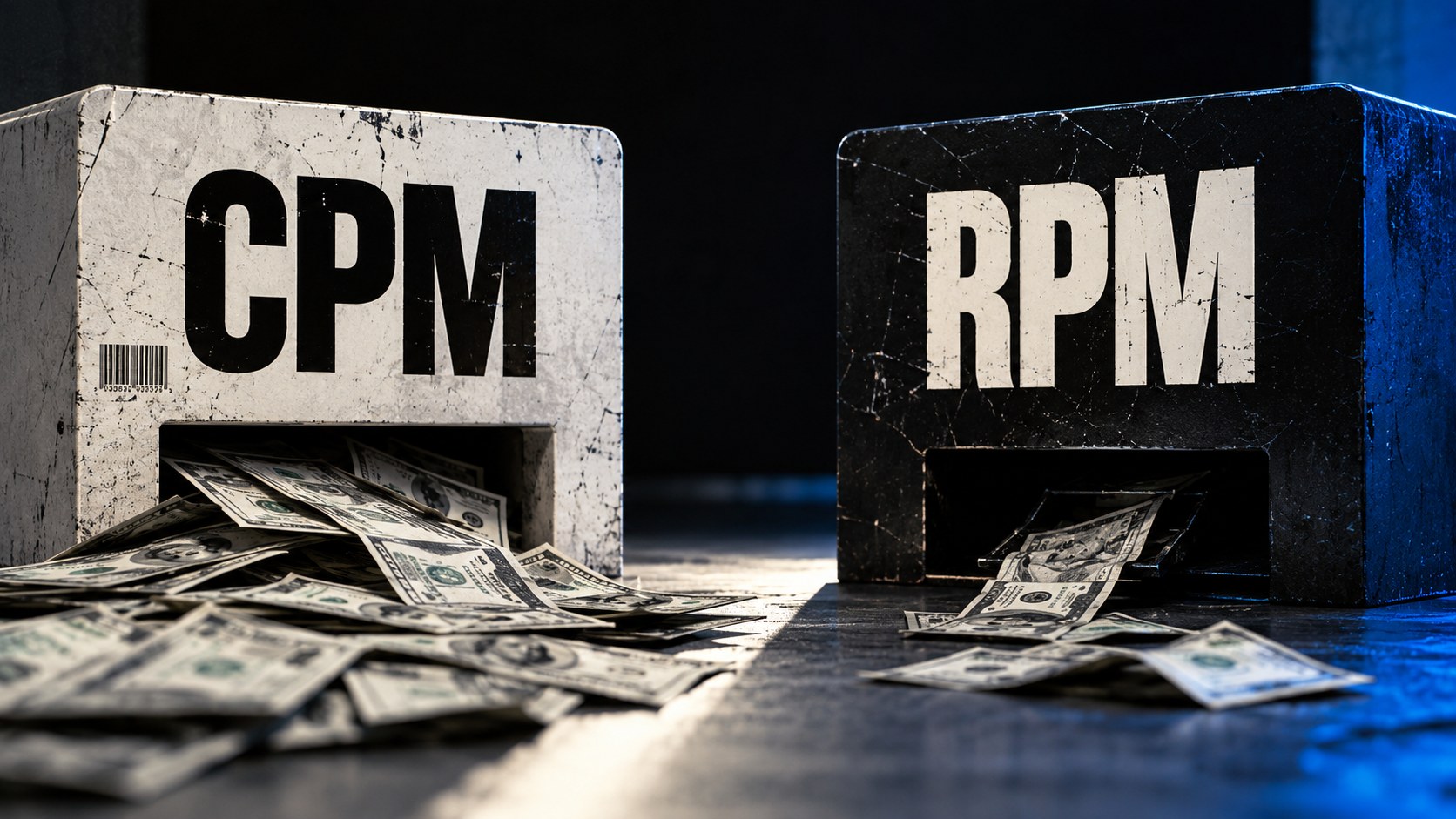
- CPM is advertiser-focused: it measures what advertisers pay per 1,000 ad impressions before YouTube's revenue share.
- Playback-based CPM uses a different denominator: 1,000 video playbacks in which at least one ad was shown.
- RPM is creator-focused: it measures the creator's reported YouTube revenue per 1,000 total video views after revenue sharing. For Shorts, YouTube uses engaged views.
- A CPM cannot be converted into RPM by simply multiplying by 55%. CPM counts ad impressions; RPM counts views, and many views do not contain an ad.
- For forecasting creator income, use the channel's own RPM from a comparable format and period. Use CPM to understand advertiser demand, not take-home pay.
CPM and RPM are measuring different sides of YouTube
Open the Revenue tab in YouTube Studio and you can easily see a CPM that looks much larger than your RPM.
That is not YouTube losing money somewhere between two dashboard cards. The two numbers are answering different questions.
CPM asks: what are advertisers paying for YouTube ad inventory?
RPM asks: how much YouTube revenue did the creator earn for every 1,000 views?
YouTube’s own analytics documentation makes the distinction explicit: CPM is advertiser-focused and calculated before revenue sharing, while RPM is creator-focused and reflects revenue after YouTube’s share.
| Metric | What it measures | Denominator | Revenue share | Best use |
|---|---|---|---|---|
| CPM | Advertiser cost | 1,000 ad impressions | Before YouTube’s share | Ad-market value |
| Playback-based CPM | Advertiser cost | 1,000 monetized video playbacks | Before YouTube’s share | Value of ad-bearing playbacks |
| RPM | Creator revenue | 1,000 total video views | After revenue sharing | Creator income and monetization |
That denominator column is the reason the numbers cannot be treated as interchangeable.
CPM is the price of advertising inventory
CPM stands for cost per mille: the cost per thousand ad impressions.
If advertisers collectively spend $80 to generate 8,000 ad impressions, the CPM is:
$80 ÷ 8,000 × 1,000 = $10 CPM
That does not mean the creator earned $10 for every 1,000 video views.
An ad impression is not the same thing as a video view. One video playback can contain no ad, one ad or multiple ads.
YouTube therefore also reports playback-based CPM, which measures advertiser spend per 1,000 video playbacks in which at least one ad appeared.
Imagine a video receives:
- 10,000 total views;
- 6,000 monetized playbacks;
- 8,000 ad impressions;
- $80 in advertiser spend.
The ordinary CPM is $10 because the $80 was spread across 8,000 ad impressions.
The playback-based CPM is $13.33 because the same $80 was spread across 6,000 monetized playbacks.
Neither number is the creator’s RPM.
The distinction exists because a playback can contain more than one ad. YouTube defines ad impressions and estimated monetized playbacks separately for exactly this reason.
RPM is the creator’s actual revenue rate
RPM stands for revenue per mille.
For long-form videos, the useful mental model is:
RPM = creator’s reported YouTube revenue ÷ total video views × 1,000
If a channel earns $450 from 100,000 views:
$450 ÷ 100,000 × 1,000 = $4.50 RPM
That $4.50 is much closer to the answer a creator usually wants when asking, “What do I make per 1,000 views?”
YouTube says RPM can include several revenue sources reported in Analytics, including ads, YouTube Premium, channel memberships, Super Chat and Super Stickers. It is therefore broader than an ad-only payout metric.
It also spreads that revenue across all views, not only the views where an ad appeared.
That is why RPM is the better number for estimating the monetization performance of a channel.
The 55% revenue share is not a CPM-to-RPM formula
One of the most common shortcuts online is:
RPM = CPM × 55%
That is not how the metrics work.
Under YouTube’s current Watch Page Monetization terms, a partner receives 55% of net revenues from ads displayed or streamed on eligible public Watch Page videos.
But that 55% applies to the revenue-sharing step. It does not make the CPM denominator disappear.
CPM is measured against ad impressions.
RPM is measured against video views.
Suppose a video receives 100,000 views. If only a portion of those views become monetized playbacks, the ad revenue generated by those playbacks is eventually spread across the full 100,000-view denominator when RPM is calculated.
Some monetized playbacks may also contain multiple ad impressions.
Then RPM can include YouTube revenue that did not come from those ad impressions at all, such as memberships or Premium revenue.
So even when the 55% Watch Page share is relevant, there is no universal conversion from a displayed CPM to a creator RPM.
Not every view is monetized
The gap between views and monetized playbacks is central to the whole calculation.
YouTube says a view may not receive an ad for several reasons. Ads may be disabled. A video may not be advertiser-friendly. No suitable ad may be available for that viewer. Geography, targeting, recent ad exposure and Premium status can also affect whether an ad appears.
That means 100,000 video views do not automatically create 100,000 monetized playbacks.
A creator multiplying a $12 CPM by 100,000 views is mixing two different units.
It is the YouTube equivalent of multiplying the price of one thing by the quantity of another.
Why CPM can move even when the channel has not changed much
CPM is useful because it says something about advertiser demand.
YouTube identifies several reasons CPM can change:
- seasonality: advertisers may bid more heavily around periods such as the holidays;
- viewer geography: ad competition differs across countries and regions;
- ad-format mix: different ad formats can carry different prices.
A channel can therefore publish similar videos to a similar audience and still see CPM move through the year.
A shift in audience geography can do the same thing. If more views begin coming from a market with less advertiser competition, CPM can fall even if the videos themselves perform normally.
CPM is a market signal.
It is not a salary.
RPM can move for more reasons than CPM
RPM is downstream from the advertising market, but it is also affected by the creator’s broader monetization mix.
YouTube notes that RPM can fall when views increase faster than monetized views, even if revenue stays unchanged. It can also rise when revenue from features such as memberships increases.
That means two channels with similar CPMs can still have different RPMs.
One may show ads on a larger share of its views.
One may have stronger YouTube Premium viewing.
One may earn meaningful membership or Supers revenue.
One may have more videos eligible for mid-roll ads.
One may simply attract a different mix of viewers and ad inventory.
This is why public claims such as “finance channels have a $20 CPM” are not enough to tell you what a particular finance creator earns per 1,000 views.
If you are estimating income, use RPM
For creator-side forecasting, the useful calculation is simple:
estimated YouTube revenue = views ÷ 1,000 × observed RPM
If a channel’s recent comparable long-form videos average a $4.80 RPM, then 250,000 views would imply roughly:
250 × $4.80 = $1,200
That is still an estimate. RPM can change with audience, season, video format and monetization mix.
But it starts from the metric that was actually designed to describe creator revenue.
Using CPM for the same forecast is much more likely to overstate earnings because CPM measures advertiser spending against ad inventory, not the creator’s revenue against total views.
For the same reason, when comparing two of your own videos, keep the format and observation window consistent. Our broader guide to reading creator analytics applies the same rule to metrics such as impressions, click-through rate and watch time: first decide what question the number is supposed to answer.
CPM still matters
RPM being more useful for income does not make CPM useless.
A creator can use CPM and playback-based CPM to understand what is happening upstream in the ad market.
If CPM rises sharply while the channel’s audience and content are stable, advertisers may be paying more to reach that audience.
If CPM remains healthy but RPM falls, the more interesting question may be whether fewer views are monetized or whether the channel’s view mix changed.
If both fall after the audience shifts geographically, advertiser demand may explain more of the movement.
The metrics become most useful when they are read together rather than ranked as good or bad.
Shorts use a different monetization system
Shorts make the CPM-to-RPM shortcut even less useful.
YouTube says RPM for Shorts is calculated against engaged views, while Shorts ad revenue comes from the Shorts Feed monetization system rather than the standard Watch Page model.
Under the current Shorts Monetization Module, creators receive 45% of the revenue allocated to them from the Creator Pool.
That is a different revenue path from the 55% Watch Page ad share used for long-form and live video.
So a long-form RPM, a Shorts RPM and a Watch Page CPM should not be compared as though they are three versions of the same metric.
They are produced by different formats and, in the case of Shorts, a different monetization mechanism.
There is no universal “good YouTube RPM”
A single benchmark sounds useful. It is usually less useful than it appears.
A “good” RPM depends on what kind of channel you run, where the audience is, how long the videos are, which formats generate the views, the season, advertiser demand and how much revenue comes from non-ad YouTube features.
The best baseline is usually your own comparable data.
Compare long-form with long-form.
Compare similar markets and periods.
Separate Shorts from Watch Page video.
Look at monetized playbacks when diagnosing ad performance.
Then use RPM when the actual question is revenue.
YouTube also makes clear that RPM does not include every way a creator can make money. Its analytics guide excludes merchandise revenue, most external brand deals and sponsorships, and indirect income such as services or consulting.
A creator with a $4 RPM could therefore run a much larger business than a creator with a $10 RPM if sponsorships, products or services make up the difference.
RPM measures YouTube monetization. It does not measure the creator’s entire company.
The number to remember
CPM is what advertisers pay for ad exposure.
Playback-based CPM is what advertisers pay per 1,000 video playbacks that actually carried an ad.
RPM is what the creator earns through YouTube per 1,000 views after revenue sharing.
If someone says a channel has a $20 CPM, you still do not know what that creator earns from 1,000 video views.
If the same creator says the channel has a $6 RPM, you finally have a number that can be applied to views for a rough YouTube-revenue estimate.
That is the practical difference.
One freshness note matters: YouTube has announced additional Partner Program changes that take effect on February 1, 2027, including changes around Premium, Shorts and eligibility. Those changes do not erase the distinction between CPM and RPM, but the monetization inputs around them can change. This article should be rechecked when the new terms take effect.
Sources & reference material
- Understand ad revenue analyticsYouTube Help · Accessed Oct 10, 2026
Defines RPM, CPM, playback-based CPM, monetized playbacks, ad impressions, the revenue sources included in RPM, and factors that can change CPM.
- YouTube partner earnings overviewYouTube Help · Accessed Oct 10, 2026
States current YouTube Partner Program revenue shares, including 55% of net Watch Page ad revenue, 45% of allocated Shorts Creator Pool revenue, and 70% of net fan-funding revenue under the Commerce Product Module.
- Check your YouTube revenueYouTube Help · Accessed Oct 10, 2026
Documents the revenue reporting categories available in YouTube Analytics, including Watch Page ad revenue, Shorts Feed ad revenue, memberships and Supers.
- Changes to the YouTube Partner ProgramYouTube Help · Accessed Oct 10, 2026
Documents announced YouTube Partner Program changes scheduled for February 1, 2027, including Premium, Shorts and eligibility changes.